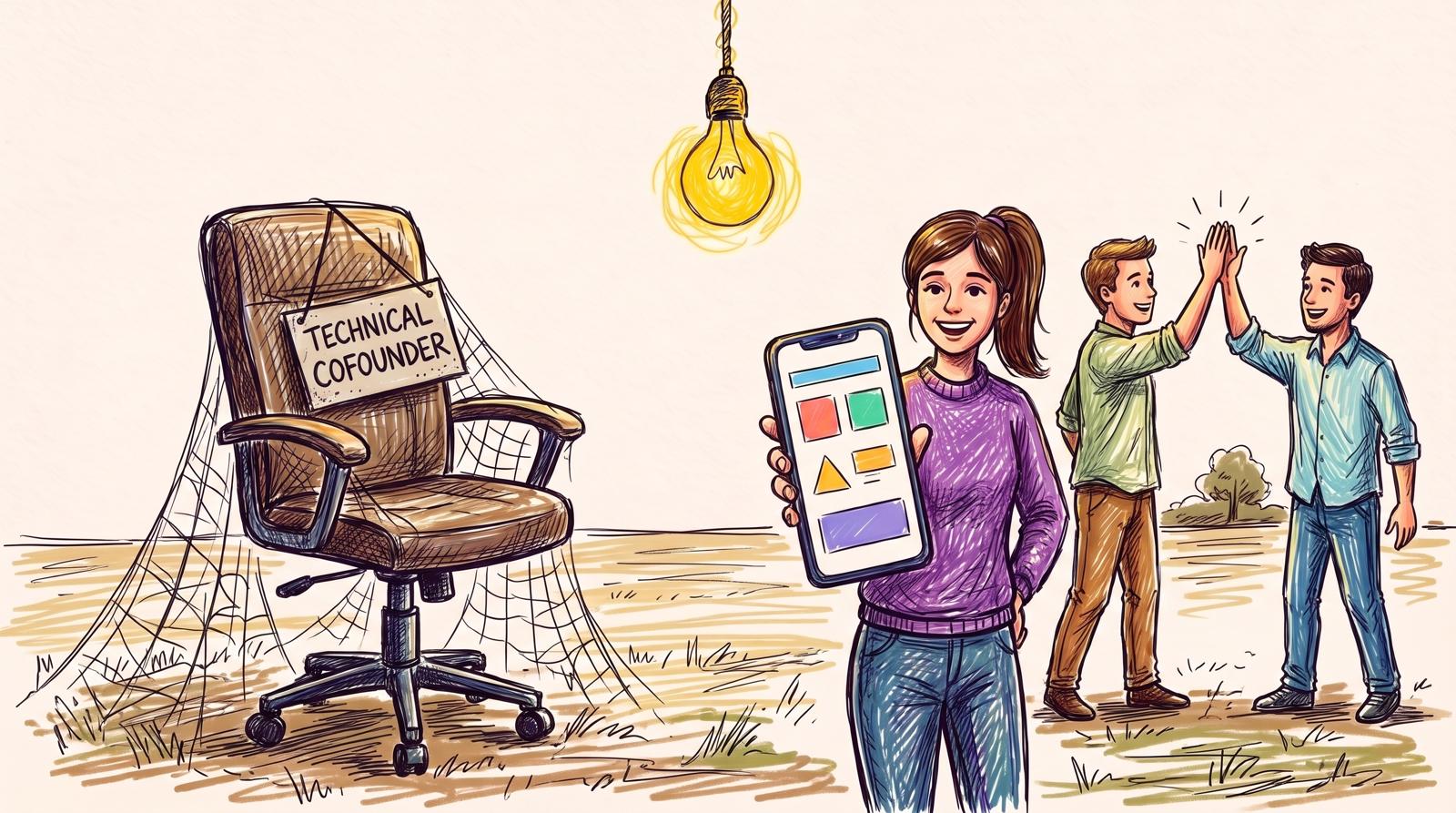

Lovable is usually the cheaper and faster way to test an idea, but it does not replace an engineer once real users, payments or personal data are involved. The SprintCode view is that, for most serious products, the best answer is a hybrid: use an AI builder for speed, and have an experienced developer review, harden and own what ships.
In this guide#
- Lovable vs hiring a developer in one minute
- What Lovable does well
- What a developer does that an AI builder cannot
- How much does each option really cost?
- Side-by-side comparison
- Security and code quality: the hidden gap
- When Lovable is enough
- When you should hire a Lovable developer
- The hybrid route: AI speed with expert review
- How to decide in five questions
- Where SprintCode Labs fits
- Frequently asked questions
Lovable vs hiring a developer in one minute#
Lovable is an AI app builder: you describe what you want in plain English and it generates a working web app. Hiring a developer means paying a person (or a team) to design, build, test and maintain the product, and to be accountable for whether it works. The two are not really rivals. They solve different parts of the same problem.
- Choose Lovable alone when you need a prototype, an internal tool or a quick test with friendly users, and nothing sensitive is at stake.
- Hire a developer when the product handles payments, personal data, complex rules or integrations, or when it has to survive growth.
- Combine both when you want the speed of AI and the safety of an expert. The SprintCode view is that this is the right call for most founders with a real business behind the idea.
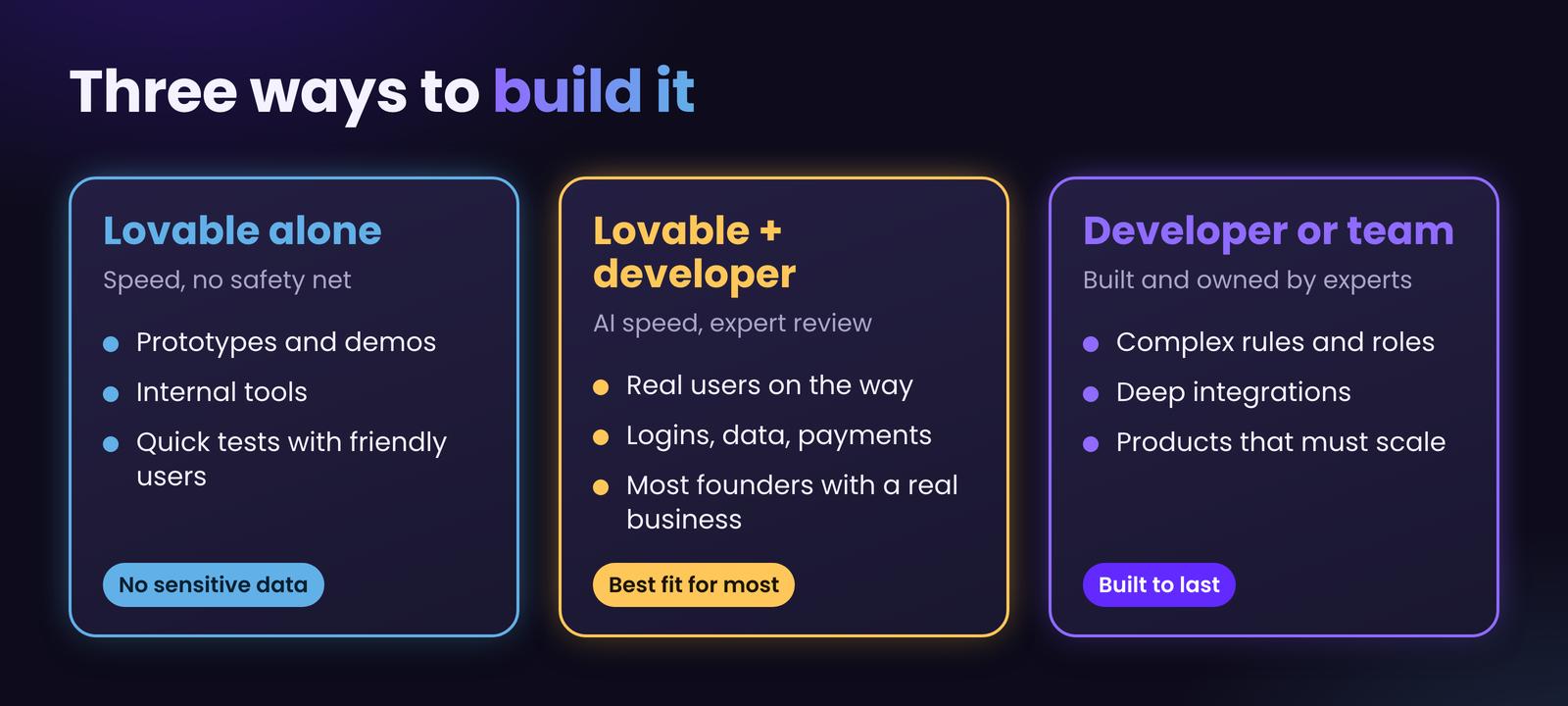
So the useful question is not "Lovable or a developer?" It is "Is Lovable alone enough, or do I need a developer for the parts that truly need one?"
Not sure which side of the line your idea falls on? Tell us about it, or read our plain-English guide to what an MVP is and what it should include first.
What Lovable does well#
Lovable removes the slowest, most repetitive part of starting a build: setup. It generates the front end and wires up a backend (its own Lovable Cloud, or your own Supabase project), so you can see something working in hours instead of weeks.
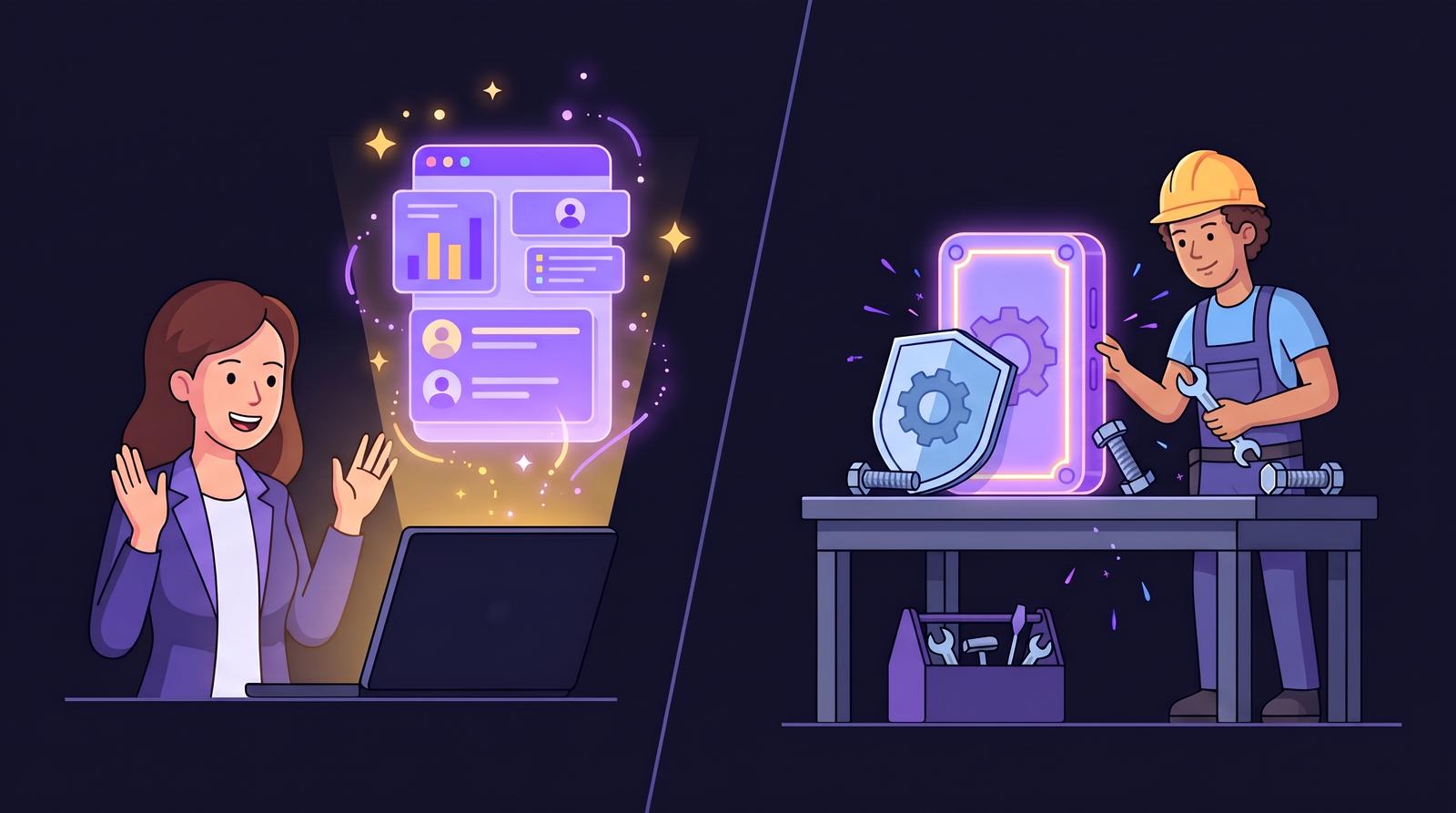
In practice, that makes Lovable strong at:
- Turning an idea into a clickable prototype over a weekend
- Testing demand with real users before spending real money
- Building internal tools and simple sites with narrow requirements
- Giving non-technical founders a way to show, not tell, when they talk to investors or developers
This is a real advantage. A founder who once faced a multi-month timeline and a large quote can now test an idea almost straight away.
What a developer does that an AI builder cannot#
An AI builder generates code. A developer is responsible for whether that code is correct, safe and easy to change. That difference in accountability is the whole story.
A developer (or a good product team) brings:
- Judgment about what to build first and what to skip. Scope decisions save more money than any tool.
- Security thinking. Who is allowed to see which record, where secrets live, how data is protected.
- Architecture. Shared logic written once, not five slightly different ways in five places.
- Handling the awkward cases. Two customers buying the last item at the same second, failed payments, retries, and edge cases that never throw an obvious error.
- Ownership after launch. Hosting, monitoring, fixes and the next feature.
AI builders tend to hit a ceiling on complex custom logic, deep third-party integrations and real production hardening. That is where a developer earns their fee.
How much does each option really cost?#
The subscription price of an AI builder is only part of the picture. Here is what each route tends to cost.
What Lovable costs#
As of November 2026, Lovable's plans include a free plan with a small daily credit allowance, Pro from $25 a month for 100 credits, Business from $50 a month, and custom Enterprise pricing. Credits pay for building, and once the small monthly allowances run out, hosting and AI features inside your finished app draw on your credits too. So your real monthly cost can drift above the headline price. Pricing has changed more than once this year, so check Lovable's own pricing page before you commit.
What a developer costs#
Rates depend heavily on location and experience, so compare written scopes and prices rather than hourly rates alone. A traditional, from-scratch build is the highest upfront cost and the longest wait of the routes below.
Calculating the savings: what the hybrid route costs#
Compare the total cost, not the subscription price. The hidden line in most comparisons is the developer time needed to review, harden and extend an AI-built app before launch. How much time that takes depends on the size of the app and how much sensitive data it handles, so ask for a written scope rather than trusting a rule of thumb. For a ballpark on your own idea, try our cost calculator.
| Route | Typical cost | Time to first version | Main catch |
|---|---|---|---|
| Lovable alone | $0 to $50 a month on entry plans, plus extra credits | Hours to days | Nobody is accountable for security or scale |
| Lovable plus developer review | Plans above, plus developer review time scoped to your app | Days to a few weeks | Needs someone who can read the generated code |
| Developer or studio from scratch | Highest upfront cost, priced by scope | Weeks to months | Highest upfront cost and longest wait |
| SprintCode Labs Pilot Sprint | $399 fixed price | About 6 working days | One working feature or prototype, not the full build |
Want a clear price instead of a range? Read how fixed price software development works for startups, or start a $399 Pilot Sprint and see something working in about six working days.
Side-by-side comparison#
| Lovable alone | Freelance developer | Product team or studio | |
|---|---|---|---|
| Speed to a prototype | Very fast | Moderate | Fast when the team works in parallel |
| Upfront cost | Lowest | Moderate | Varies from low to very high |
| Security review | Not included by default | Depends on the person | Should be built into the process |
| Handles complex logic | Limited | Yes, in their specialty | Yes, with the right specialists |
| Who you manage | Yourself | The developer, and you become project manager | A delivery lead, ideally |
| Long-term maintenance | You, or a developer you hire later | One person, one queue | Included in a care plan, if offered |
| Best for | Prototypes, tests, internal tools | Well-defined tasks in one skill | Products that must scale and last |
Security and code quality: the hidden gap#
This is where the comparison matters most, because the problems stay invisible until someone exploits them.
AI code often works but is not safe#
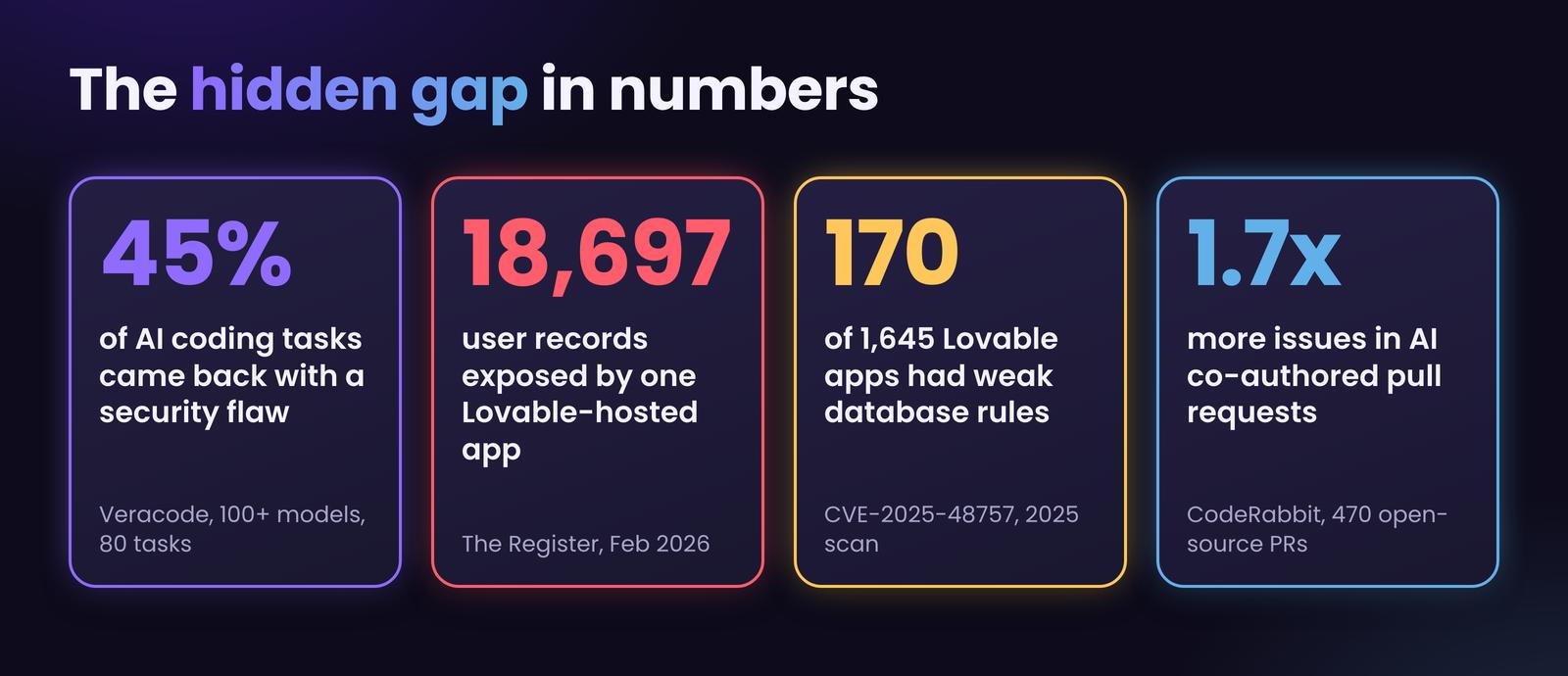
Veracode tested more than 100 language models on 80 coding tasks and found that the AI-written code introduced security flaws in 45 percent of cases. The code ran fine. It just was not secure.
Real Lovable examples#
In February 2026, The Register reported that a researcher found 16 vulnerabilities, six of them rated critical by the researcher, in a single Lovable-hosted app that exposed 18,697 user records. To be fair to the platform, Lovable said every project gets a free security scan before publishing, and that this app included code Lovable did not generate and used a database Lovable did not host.
Earlier, in 2025, a researcher scanned 1,645 Lovable apps and found that 170 of them (about 10 percent) had missing or weak database access rules, which let outsiders read data they should not see. The issue is on public record as CVE-2025-48757, and Lovable disputes it.
The lesson is not that one tool is uniquely bad. It is that generated code needs a human who knows what to look for. A scan is a useful first pass, not a sign-off.
The lock works, but on the wrong door#
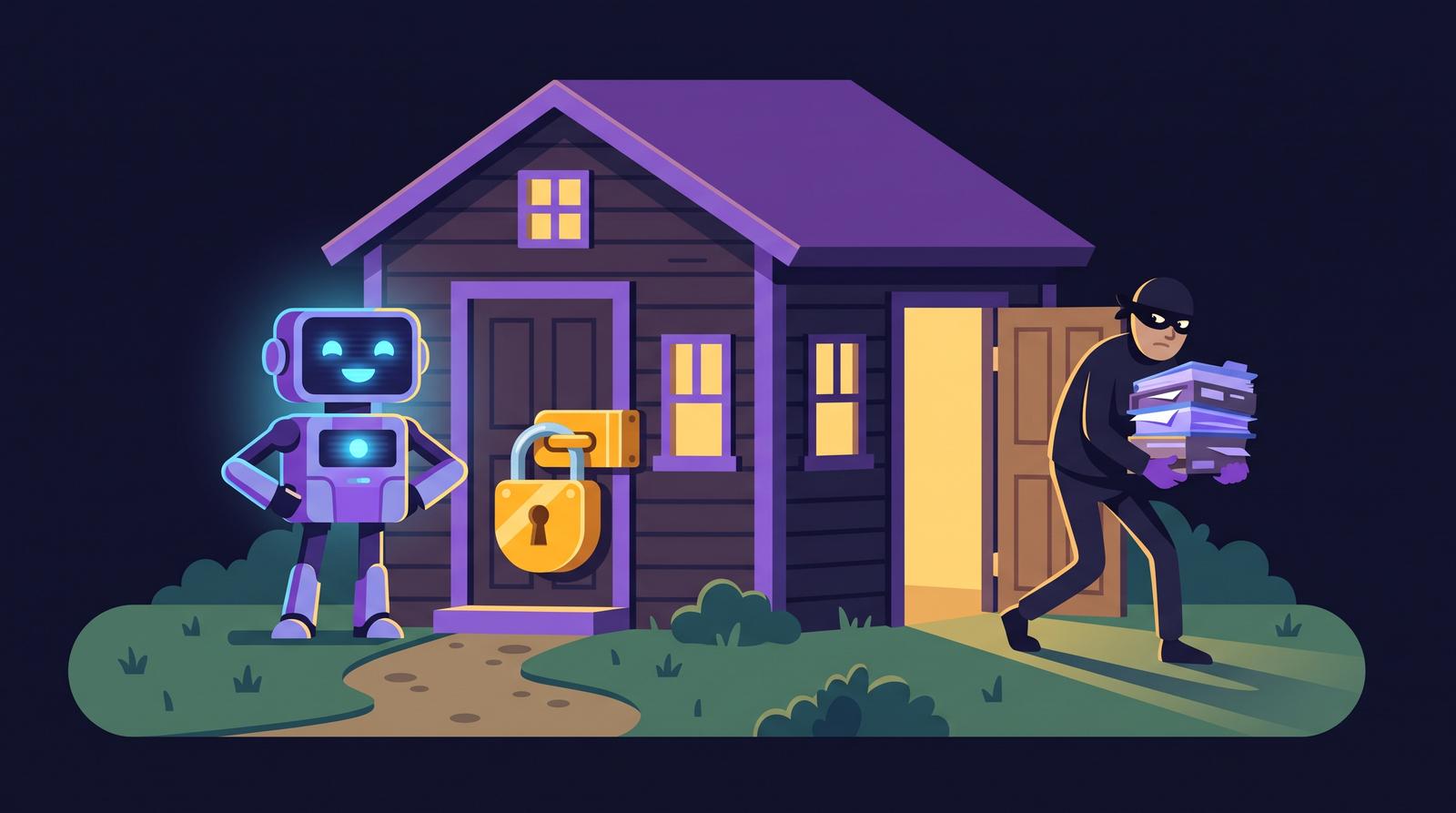
Broken object level authorization is number one on the OWASP API Security Top 10. In plain terms, an app checks that you are logged in but not whether you are allowed to see this particular record. That is how one customer ends up seeing another customer's invoices. AI tools can miss this because the app still appears to work.
Code that gets harder to change#
Quality problems also add up. In CodeRabbit's study of 470 open-source pull requests, AI co-authored changes had about 1.7 times more issues than human-only ones. (CodeRabbit sells AI code review, so read it as one data point.) An AI-built codebase also tends to get harder to extend as it grows, unless someone keeps it tidy. If you plan to grow the product, that matters.
Curious how we keep AI on a short leash in our own work? Read how we gave an AI agent memory and strict limits, and see how a senior engineer reviews every change before it ships.
When Lovable is enough#
Lovable on its own is a sensible choice when most of these are true:
- You are testing an idea and can afford to throw the first version away
- The app holds no sensitive personal data and takes no payments
- The logic is simple and the integrations are standard
- The users are a small, known group (a pilot, an internal team, a demo)
- You, or someone you trust, can spot when something looks wrong
For this kind of work, an AI builder is usually far cheaper than a developer. The gap only narrows when compliance, complex integrations or production hardening enter the picture.
Lovable vs traditional coding: which is faster for building an internal app without hiring a developer?#
Lovable is faster. It can produce a working internal app in hours to days, while a traditional build takes weeks to months and needs a developer you have to find, brief and manage. That speed holds while the app stays simple and holds no sensitive data. Once it stores staff records, customer details or payments, "without hiring a developer" stops being safe, because someone has to check who can see which record. AI tools often miss this, since the app still looks like it works. The fastest route that stays safe is to have us build it. Our Pilot Sprint is a $399 fixed price that delivers a working feature or prototype in about six working days, and you never hire, brief or manage a developer. We use the same AI tools, with an engineer checking what ships.
When you should hire a Lovable developer#
Bring in an experienced developer or product team when any of these apply:
- Customers will enter payment details or personal information
- The product must meet compliance or enterprise security requirements
- You need custom business rules, multi-user roles or deep third-party integrations
- The prototype has real users and is starting to break or slow down
- Each new prompt seems to break something else
- You are a solo, non-technical founder who will need ongoing maintenance as you grow
If you do hire, write down the scope first, so nobody scopes it for you. Who to look for is covered next.
How do you hire a Lovable developer or Lovable expert?#
Hire an engineer who can read, secure and extend what Lovable generated. You do not need a Lovable-only specialist: Lovable apps are backed by editable code that you can sync to GitHub, so an experienced web developer, or a team that takes over AI-built apps, can review, change and hand the work on. We do this through our vibe-coded app cleanup service and our take-over service. Check that whoever you hire has done this before, because reading AI code is its own skill. A $399 Pilot Sprint on one risky flow is a low-risk way to see how a team works in your code.
Already built something in an AI tool and not sure it is safe to launch? See our vibe-coded app cleanup service, or talk to us and we will tell you honestly what needs fixing.
The hybrid route: AI speed with expert review#
For most founders, the smartest path is neither extreme. Here is a simple way to run it:
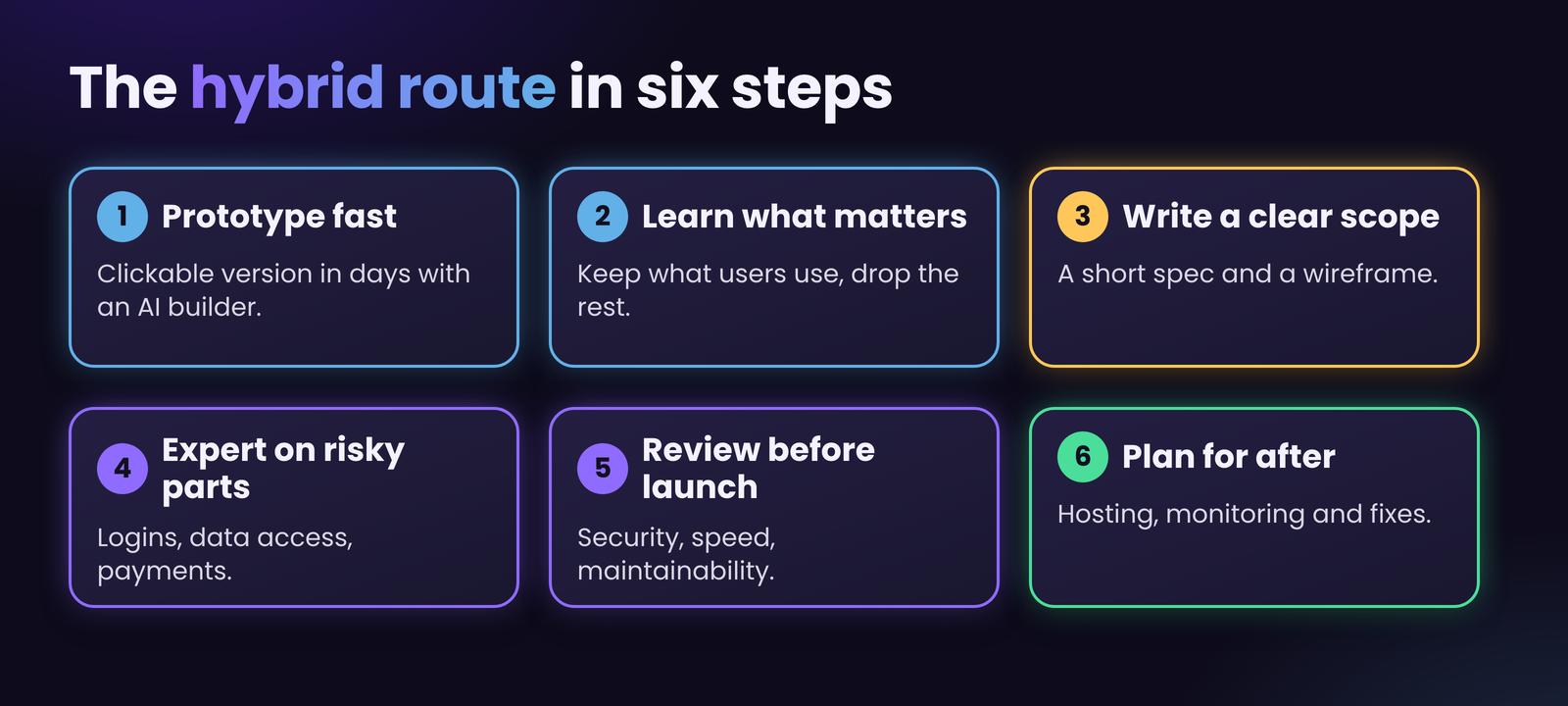
- Prototype fast. Use an AI builder to get a clickable version in front of users within days.
- Learn what matters. Keep the features people actually use and drop the rest.
- Write a clear scope. Turn what you learned into a short written spec and a wireframe.
- Bring in an expert for the risky parts. Logins, data access, payments, integrations and anything tied to money or privacy.
- Review before launch. Have an engineer check security, speed and how easy the code is to change.
- Plan for after launch. Budget for hosting, monitoring and fixes, whichever route you chose.
This is also close to how a good product team works inside. AI tools make the team faster, and senior engineers decide when to trust them and catch what they get wrong. In our projects, that means a written scope before any code, a live board with a written update every working day, a senior engineer reviewing every change, and 30 days of free bug fixes after delivery.
How to decide in five questions#
Answer these honestly:
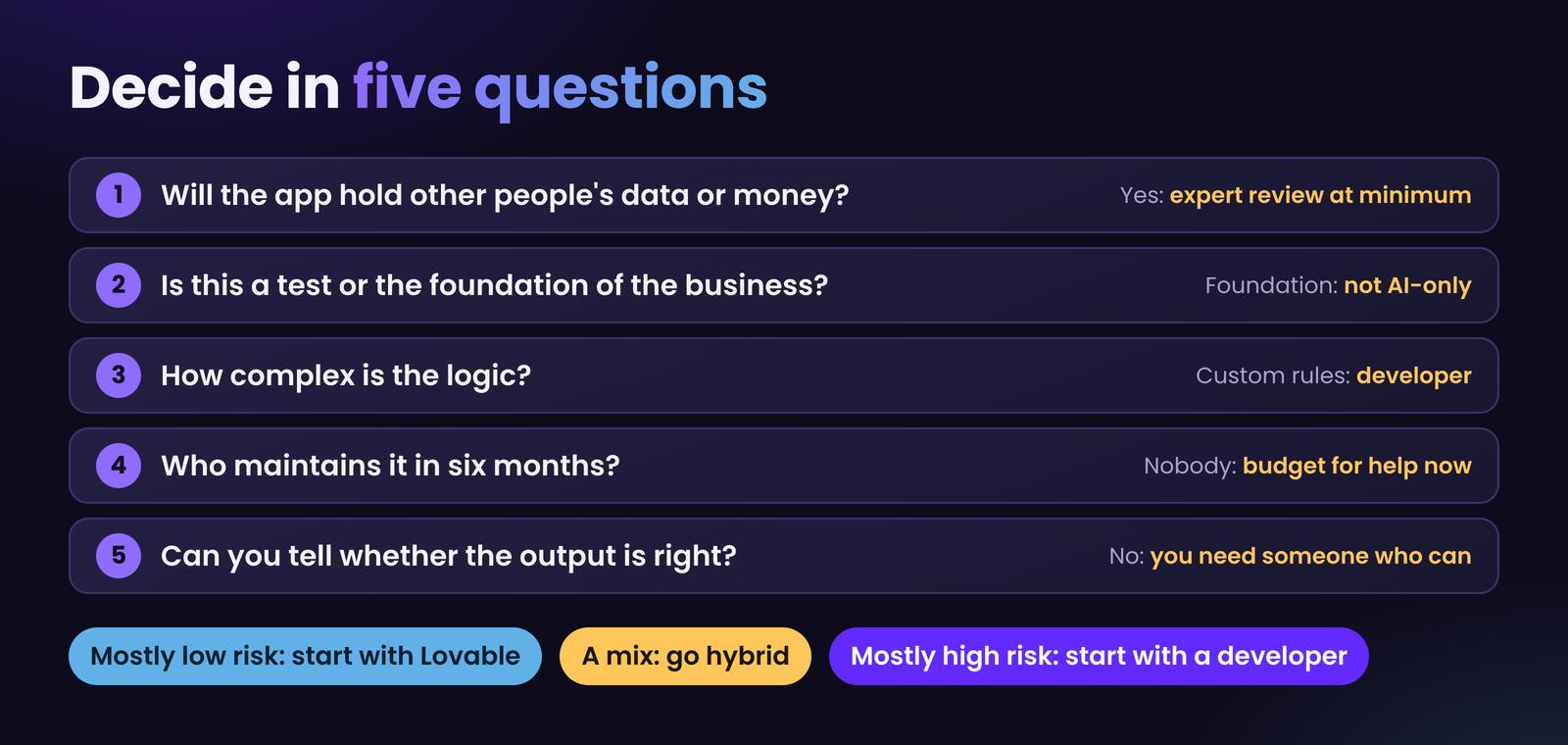
- Will the app hold other people's data or money? If yes, plan for expert review at minimum.
- Is this a test or the foundation of the business? Tests can be AI-only. Foundations should not be.
- How complex is the logic? Standard forms and lists suit an AI builder. Custom rules and integrations suit a developer.
- Who maintains it in six months? If the answer is nobody, budget for a developer or a care plan now.
- Can you tell whether the output is right? If not, you need someone who can.
Mostly "low risk, simple, throwaway"? Start with Lovable. Mostly the opposite? Start with a developer or a product team. A mix? Go hybrid.
Where SprintCode Labs fits#
We are a product development studio for founders who do not have a product team. You hand us a business problem, and we hand back working software plus the judgment around it: what to build first, what to skip, and what will break later.
- Freelancer pricing, agency standards. A team works in parallel instead of one person handling everything in a single queue.
- AI plus experts. We use the same AI coding tools everyone has, including Claude Code, Cursor and Codex. Our value is the senior engineers who know when the AI is wrong and stand behind what ships.
- Phone-first and async. A written update every working day, a live board you can check any time, and quick questions you can answer from your phone instead of meetings that take over your calendar.
- No lock-in contracts. Scale up, scale down or stop when you need to.
We are not the right fit for everyone. If a Lovable prototype is enough to test your idea, you do not need us yet. If you want weekly meetings or a large in-house-style team, a different kind of partner will suit you better.
Not ready for a full build? Our Pilot Sprint is a $399 fixed-price way to try us on a real piece of your product, with a working feature or prototype delivered in about six working days.
Ready to move?
- Start a Pilot Sprint for $399, fixed price
- Book a free call with us, no pitch deck needed
- Explore SprintCode Labs and our featured work
Frequently asked questions#
Is Lovable cheaper than hiring a developer?#
For early testing, internal tools and simple sites, yes. Lovable's subscription and credits usually cost far less than developer time. The gap narrows once you need compliance, complex integrations or production hardening.
Lovable vs traditional coding: which is faster for building an internal tool for my team?#
For a simple tool that only your team uses, Lovable is faster: a first version in hours to days, against weeks for traditional coding. Traditional coding only becomes the better choice when the tool needs custom business rules, deep integrations or strict access control. The catch is that team tools quietly collect real data, such as client names, pricing or staff details, so someone should check who can see what before everyone logs in. If you want the speed without being the person who checks, we build internal tools as a $399 fixed-price Pilot Sprint, with a working first version in about six working days, and we review access before we hand it over.
Can Lovable replace a developer?#
For a prototype, often yes. For a product that handles payments, personal data or custom logic, no. Lovable generates code, but a developer is accountable for whether it is correct and secure.
Is Lovable secure enough for a real product?#
Lovable includes a free security scan before publishing, but research shows AI-generated code regularly contains vulnerabilities, and Lovable-built apps have exposed user data. Treat the scan as a first check and have an engineer review anything that handles real user data.
How much does it cost to hire a developer to fix a Lovable app?#
It depends on the size of the app and how much sensitive data it handles, so be wary of any fixed figure quoted before someone has seen the code. We scope each app in writing and give a clear price before any work starts.
Can a developer take over an app built in Lovable?#
Yes. Lovable apps are backed by editable code that can be synced to GitHub, so an experienced web developer can review and extend them. A clear scope and a short handover review make the switch smoother.
Should I start with Lovable and hire a developer later?#
Often that is a good plan, as long as you treat the first version as a draft and budget for a review before real users arrive. If you already know the product will hold sensitive data, involve an engineer from the start.
What are the disadvantages and risks of Lovable vs hiring a developer?#
The main risks of Lovable alone are security, rising cost and code that gets harder to change. AI code often works but is not safe: one study found security flaws in 45% of tested cases. Hosting and AI features can draw on your credits, so the monthly bill can drift above the headline price. An AI-built codebase also tends to get harder to extend as it grows. A developer costs more upfront and takes longer to start, but is accountable for the result. The hybrid route gives you speed first and review before real users arrive.
Lovable vs traditional coding: which is faster for building a subscription-based SaaS product?#
Lovable is faster to a first version: a working demo can appear in days, against weeks for traditional coding. Subscriptions are where AI-only builds get risky, because the app must take payments, store customer details and keep each customer's data separate from everyone else's. So should you build your SaaS with Lovable or hire developers? Use Lovable to test demand, and bring in an engineer before real customers pay. We can run that step for you. Our $399 Pilot Sprint delivers one working feature or prototype in about six working days, and a full MVP build starts with a written scope and a clear price.
Is Lovable suitable for enterprise development?#
Lovable has an Enterprise plan with custom pricing, but a plan is not the same as meeting enterprise requirements. If your product must meet compliance or enterprise security requirements, an engineer needs to check the generated code against those rules before it goes live. Tell us what you need to meet and we will say honestly what to fix first.
What is a Pilot Sprint?#
It is our entry offer: a $399 fixed-price piece of work that delivers a working feature or prototype in about six working days, with daily updates on a shared board. Start a Pilot Sprint or read our guide to fixed price software development.
Written by the SprintCode Labs team, a senior product team that builds MVPs and custom software for founders.