
Fixed price software development means you agree on the scope, the deadline and the price before any code is written, so there are no surprise invoices. The SprintCode view is that, for startups, it is the safest way to build an MVP, a web app or a first product. At SprintCode Labs, you can start with a $399 Pilot Sprint and see something working in about 6 working days.
Ready to skip the reading? Book your Pilot Sprint and get a fixed quote.
In this guide#
- What is fixed price (fixed cost) software development?
- Why fixed price software development works for startups
- Fixed price MVP development: what you actually get
- Fixed price web app development: how scope stays under control
- Fixed price vs hourly vs freelancer vs AI app builders
- Fixed price app development for startups: our process
- When fixed price is not the right fit
- How to choose a fixed price development partner
- Start with a $399 Pilot Sprint
- FAQs
What is fixed price (fixed cost) software development?#
Fixed price software development, also called fixed cost software development, is a contract model where the cost, scope and delivery timeline are agreed upfront. You pay the agreed amount for the agreed deliverables, however many hours the team spends.
This is different from hourly (time and materials) billing, where the final cost depends on how long the work takes. With a fixed price, the development partner carries the risk of the estimate, not you.

It is most useful when you know what problem you are solving, even if you do not yet know every technical detail.
What is a fixed price contract in software development?#
A fixed price contract is the written agreement behind it: it sets the scope, the deadline and the total price before work starts. You may also see fixed scope software development or fixed price software projects. The names differ, but the promise is the same: you know what you get, when you get it and what it costs. With us, the scope is written down and new ideas are priced separately. There are no lock-in contracts, so you are never tied in beyond the work you agreed.
Why fixed price software development works for startups#
Startups run on tight budgets and tight timelines, and fixed price protects both. Here is what founders usually get from it:
- Budget certainty. You know the total cost before you commit.
- Faster decisions. A clear scope forces clear priorities: what to build first and what to skip.
- Less management work. You are not tracking hours or reviewing timesheets.
- Lower risk. If the first phase does not work out, you have not burned through an open-ended budget.
- Easier investor conversations. A defined build cost makes your runway easier to plan and explain.
Non-technical founders gain the most, because they do not have to judge whether 200 hours was a fair estimate. They only have to judge whether the result solves their problem.
Fixed price software development for bootstrapped founders with limited runway#
If your runway is short, a fixed price is the safest way to spend it: you know the cost before you commit, so one build cannot quietly eat your savings. Start with the smallest useful step. Our $399 Pilot Sprint is a fixed price for one real piece of your product, and if you go on to build with us, the $399 comes off your first build invoice. Then you decide on the next phase with real results in hand.
Fixed price MVP development: what you actually get#
Fixed price MVP development delivers the smallest working version of your product that can test your idea with real users. An MVP is not a rough demo. It is a focused product that does one job well. Eric Ries, who popularised the term, described it as the version that gathers "the maximum amount of validated learning about customers with the least effort". (New to the term? Read What Is an MVP? first.)
A good fixed price MVP engagement should include:
- A clear list of core features (and an equally clear list of what is not included)
- UI design that real users can understand without a manual
- A working backend and database
- Basic security and testing
- A live version you can put in front of customers or investors
- A handover, so you own the code and are never locked in
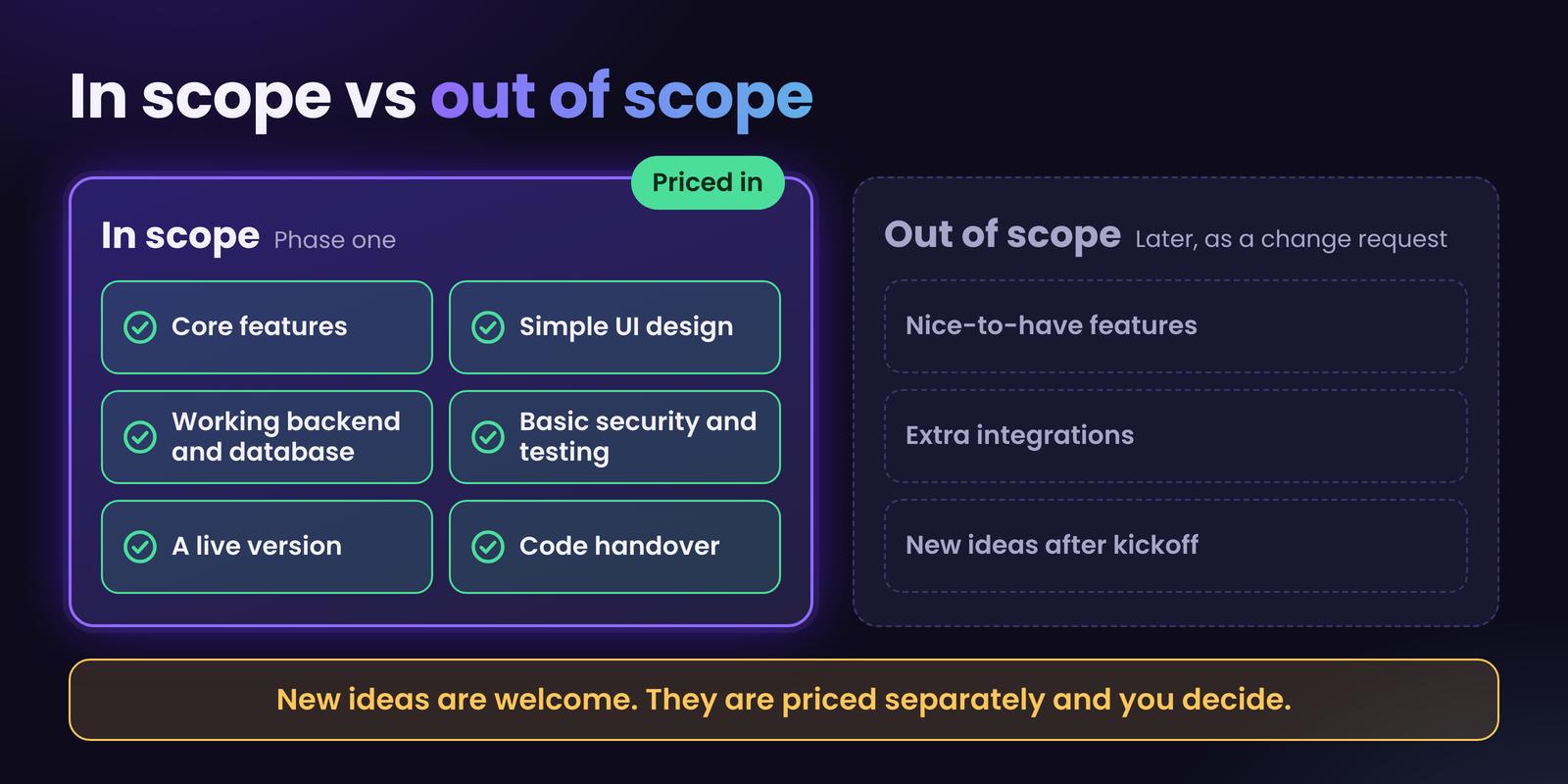
The most cost-effective MVP is usually not the biggest one. We build the option with the fastest time to market, and we tell you honestly which features can wait until you have real user feedback.
Fixed price web app development: how scope stays under control#
The biggest risk in fixed price web app development is scope creep, and the fix is a written scope with a change process. Scope creep happens when new requests keep arriving after the price is set.
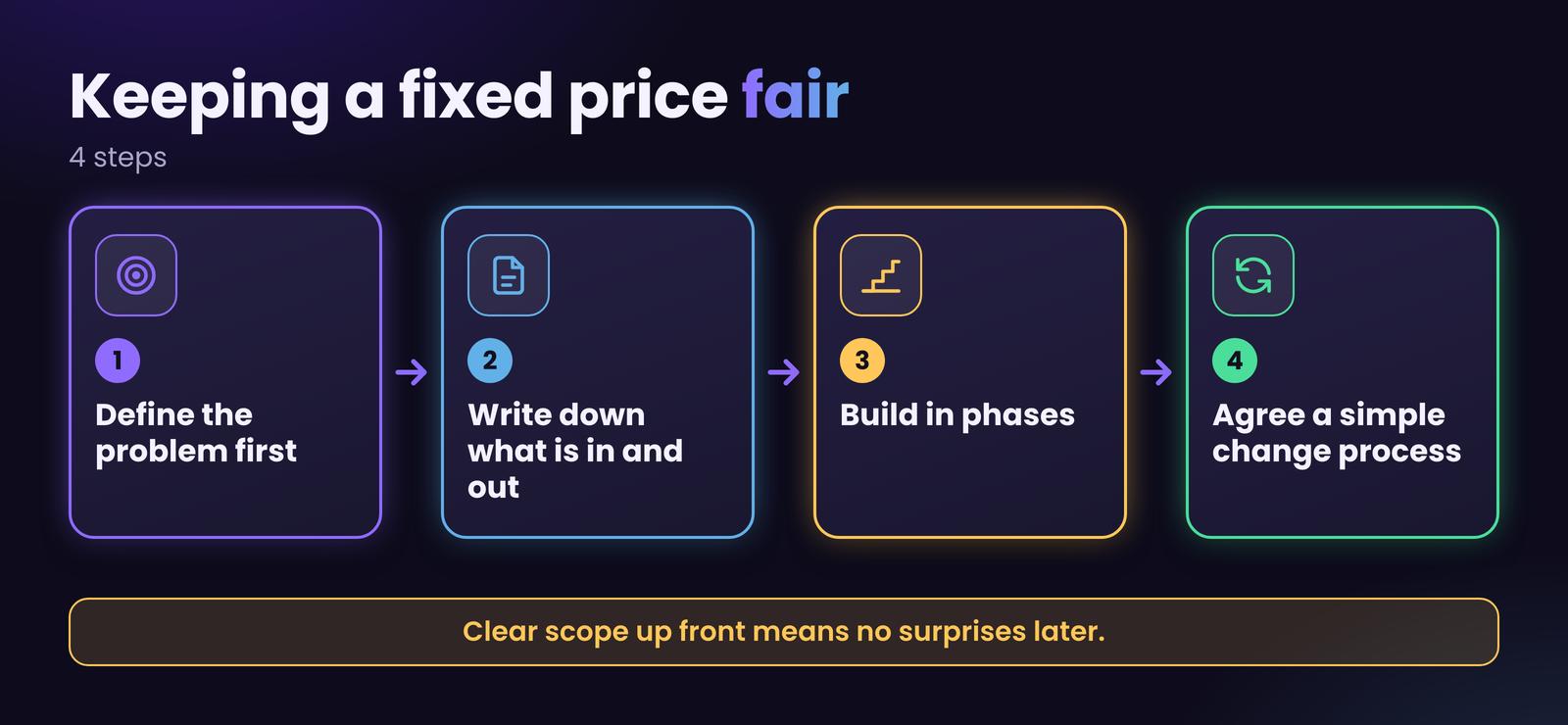
Here is how we keep a fixed price fair for both sides:
1. Define the problem before the features#
We start with the business problem. Features follow from it, not the other way around.
2. Write down what is in and out#
Every project has a short scope document. If an idea is not in it, it is a change request, not a surprise.
3. Prioritise in phases#
Phase one covers what you need to launch. Phase two covers what you want once users show up.
4. Agree a simple change process#
New ideas are welcome. We estimate them separately, and you decide whether to add them.
This is how web apps such as multi-tenant SaaS platforms, booking systems and data dashboards can be built at a predictable price.
Fixed price vs hourly vs freelancer vs AI app builders#
Which option is best depends on how clear your scope is and how much risk you can carry. This table compares the main ways startups build software today.
| Option | Cost certainty | Speed | Who manages the work | Accountability for quality |
|---|---|---|---|---|
| Fixed price studio (SprintCode Labs) | High: price agreed upfront | Fast: a team works in parallel | The team manages itself | High: experts stand behind what ships |
| Hourly agency | Low: cost grows with hours | Medium | Often you | Medium |
| Solo freelancer | Medium | Slower: one person, one queue | You | Depends on the person |
| In-house team | Medium: salaries are known, the build time is not | Slow to start: hiring comes first | You | High, once the team is in place |
| DIY AI app builders | High for prototypes | Very fast | You | Low: nobody checks security, correctness or scale |
| Large studio or offshore firm | Medium | Medium | Account managers | High, but often with larger minimum budgets |
In short: a small, founder-led studio gives you freelancer-level cost with team-level speed, and an expert reviewing what the AI tools produce.
Fixed price app development for startups: our process#
Our process is built to take as little of your time as possible. There are no calendar-eating meetings. Updates reach you on your phone.
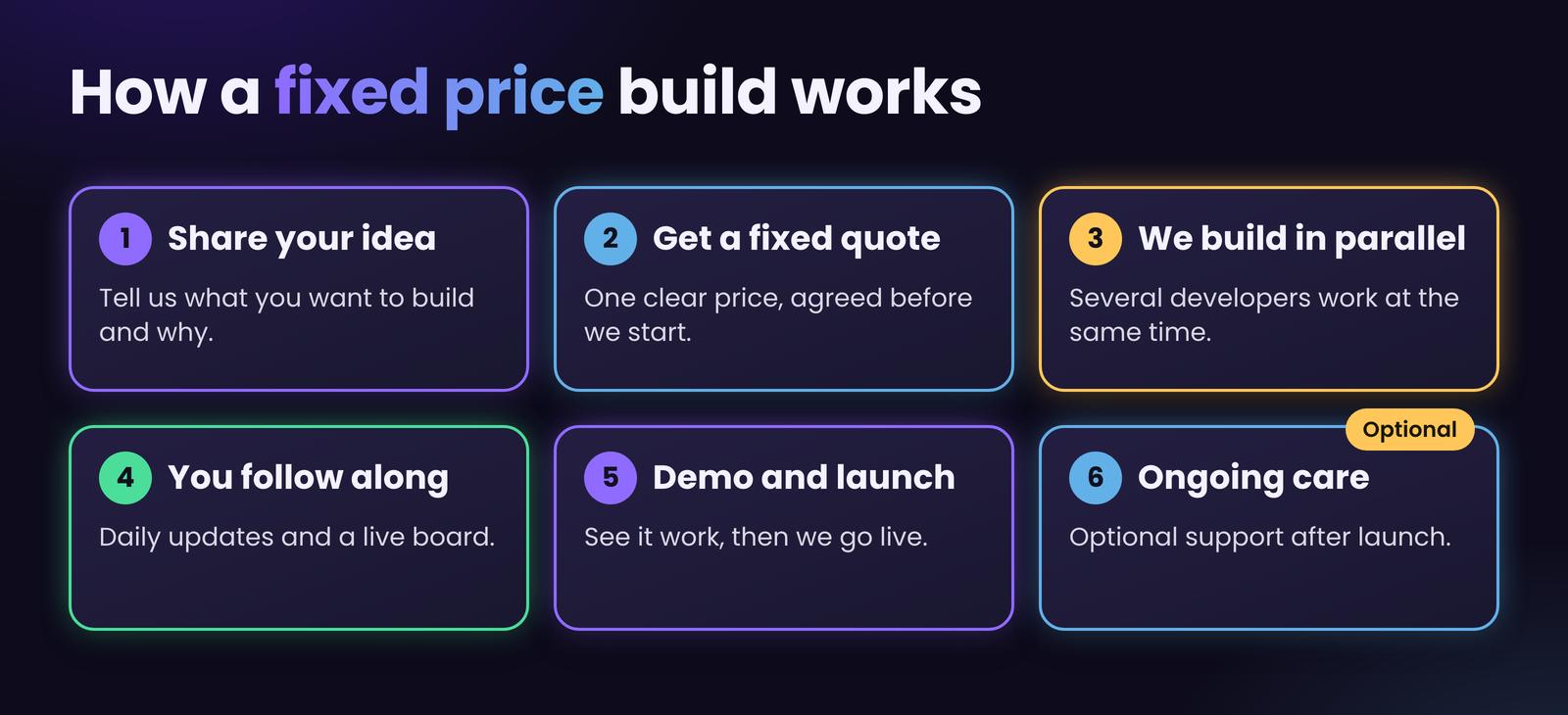
- Share your idea. Tell us the problem you want to solve. A short form or a quick message is enough.
- Get a fixed quote. We confirm scope, timeline and price in writing.
- We build in parallel. We bring in the specialists your project needs, such as UI design, backend, data pipelines or AI.
- You follow along. You get daily updates and a live progress board. We only ask for input when it really matters.
- Demo and launch. One of our biggest e-commerce builds took just two meetings: a kickoff and a final demo.
- Ongoing care. If you want it, we offer hosting, maintenance and care plans. There are no lock-in contracts.
In our projects, a senior engineer reviews every change before it ships, and we fix bugs for free for 30 days after delivery. The written scope and the price come before any code, so the figure you approve is the figure you pay for that scope.
Want to see how this would work for your idea? Send us a message and we will reply with next steps.
When fixed price is not the right fit#
Fixed price is not ideal when the scope is truly unknown. Being honest about this is part of building trust.
Fixed price may not suit you if:
- You are still researching what the product should even be
- Requirements will change every week as you learn
- The work is open-ended research with no clear deliverable
The SprintCode view is that a small, fixed price first step is the better move in these cases, like a pilot, so you learn quickly without committing to a large build.

How to choose a fixed price development partner#
A good fixed price partner is clear about scope, honest about trade-offs and easy to reach. Before you sign with anyone, ask:
- Will I speak directly with the people building my product?
- What is in the scope, and what is out?
- How are change requests handled, and what do they cost?
- Do I own the code and the data?
- Is there a lock-in contract?
- Who checks the AI-generated code before it ships?
- Can I try you on a small project first?
That last question matters most. A low-risk starting point tells you more than any sales pitch.
Start with a $399 Pilot Sprint#
The Pilot Sprint is our entry offer: $399 fixed price, with something working delivered in about 6 working days. It is the lowest-risk way to try SprintCode Labs before committing to a full build.
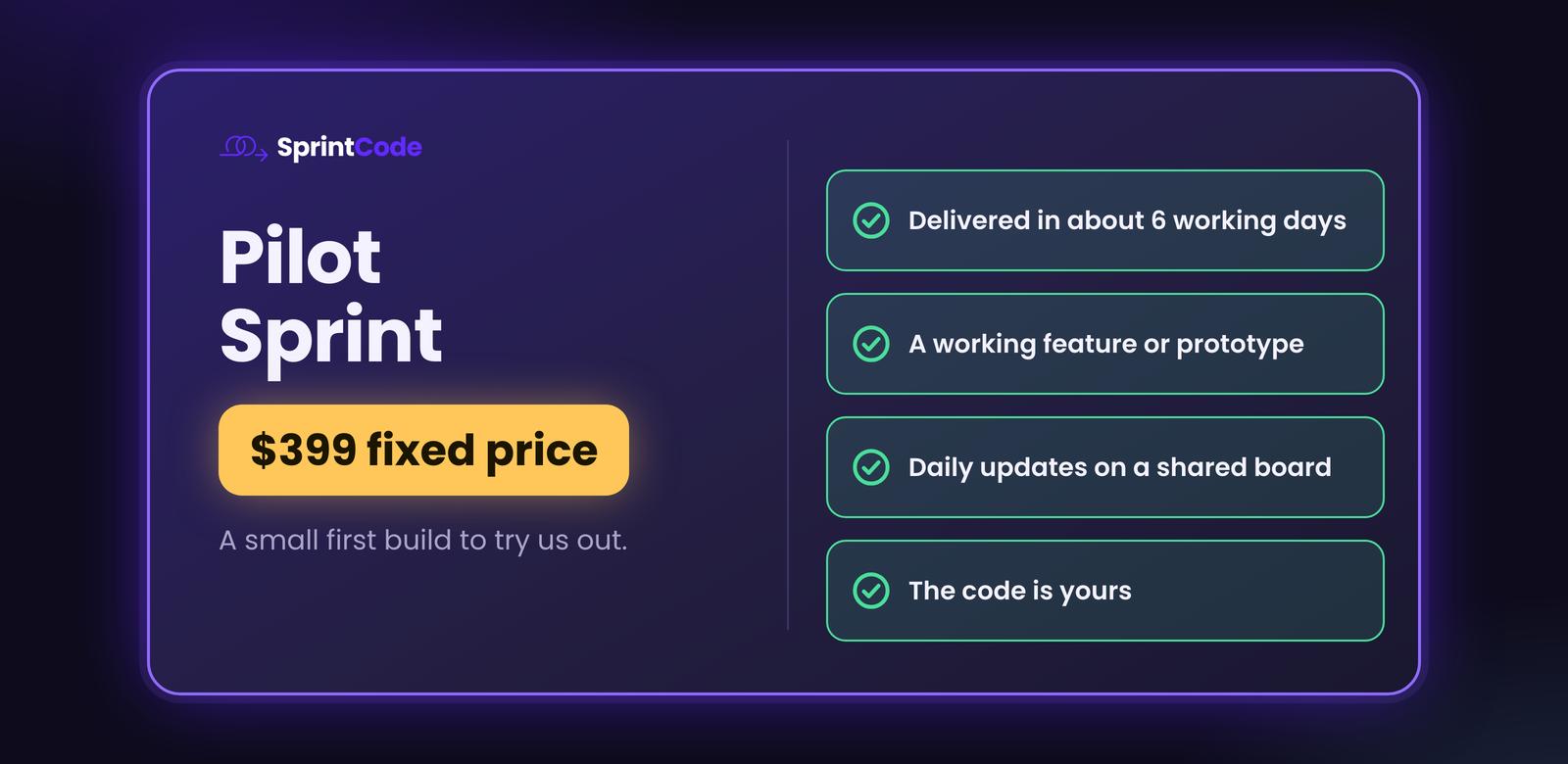
It is a good fit if you:
- Have a clear idea but no product team
- Want to test an MVP concept quickly
- Need a working prototype to show customers or investors
- Want to see how we work before a bigger project
We are the product team for founders who don't have one. We have delivered 43+ projects for clients in 9 countries, and you always talk to the founder.
FAQs#
What is fixed price software development, or fixed cost software development?#
It is a pricing model where you agree on the scope, timeline and total cost before work begins. You pay the agreed amount for the agreed deliverables, not for hours worked.
How much does fixed price MVP development cost?#
It depends on the features, the design needs and the integrations. Large studios often set higher minimum budgets than a lean MVP needs. At SprintCode Labs, you can start with a $399 Pilot Sprint, then get a fixed quote for the full MVP once the scope is clear. You can also get a ballpark from our MVP and app cost calculator.
How long does fixed price web app development take?#
Timelines depend on scope. A Pilot Sprint delivers something working in about 6 working days. A full build is planned in phases, and we confirm the timeline in your written quote.
Is fixed price app development good for startups?#
Yes, in most cases. It gives startups budget certainty, faster decisions and less management work, especially for non-technical founders. It works best when the core problem is clear.
How do fixed-price MVP development agencies compare with hiring freelancers or an in-house team?#
A fixed-price agency gives you a known scope, deadline and price before work starts, so the agency carries the risk of the estimate, not you. A freelancer is usually cheaper and hands-on, but one person works through a single queue and you end up managing them. An in-house team gives the most control in the long term, yet it is the slowest to assemble and the most expensive to keep, because you pay salaries whether or not there is work. The SprintCode view is that, for a first MVP with no product team, a fixed-price agency is usually the quickest and lowest-risk start. You can hire in-house later, once the product has proven itself. To try us first, our $399 Pilot Sprint delivers a working feature or prototype in about 6 working days.
What is the best fixed price software development company for a startup?#
The best fit depends on how clear your scope is and how much risk you can carry, so judge every company on the same few things: a written scope, a price you can see before work starts, a named person you can talk to and no lock-in contract. The questions in the section on choosing a partner above will help. Our own entry point is a $399 Pilot Sprint, so you can see the work before you commit to more.
Who offers fixed-price custom software development for a startup?#
We do. Custom software development at SprintCode Labs starts with a written scope and a clear price before any code is written, and our MVP development works the same way. Large studios often set higher minimum budgets, so the SprintCode view is that a small founder-led studio is usually the better fit for a first product. To try us first, start with a $399 Pilot Sprint.
What happens if I want to change the scope?#
Changes are welcome. We estimate the extra work separately and you decide whether to add it, so the original price stays fair.
Do I own the code?#
You should, with any partner, so ask before you sign. With us, yes: the code is yours, fully documented, and there are no lock-in contracts.
Can AI tools replace a development team?#
AI tools are fast for prototypes, but nobody is accountable for security, correctness or scale. We use AI tools too, with experts who know when the AI is wrong and who stand behind what ships.
How do I get started?#
Tell us about your idea in a few lines, or book a Pilot Sprint. We will reply with a fixed quote.
Build your first version without the guesswork. Start your fixed price project with SprintCode Labs.
Written by the SprintCode Labs team, a senior product team that builds MVPs and custom software for founders.