
A founder-led software agency gives startups a small senior team, a founder who stays involved in scope and quality, and a much lower entry price than large agencies. If you want an agency that answers you quickly and knows your project, the SprintCode view is that a small software studio for founders is usually the best fit. Start a conversation.
In this guide#
- What Is a Founder-Led Software Agency?
- Why Startups Choose a Small Software Development Agency
- Small Studio vs Freelancer vs Large Agency vs AI Builder
- What Does a Boutique Software Development Agency Cost?
- How to Find an Agency With a Short Chain of Communication
- How SprintCode Labs Works as a Small Software Studio for Founders
- 7 Questions to Ask Before You Hire a Small Software Agency
- Frequently Asked Questions
- Final Thoughts
What Is a Founder-Led Software Agency?#
A founder-led software agency is a software company where the founder is still involved in the work: setting the standards and staying close to scope and quality. You work with a team that runs on those standards, not a rotating cast of account managers.
In practice, that usually means:
- Clear ownership. Someone who knows your project is accountable for the result.
- Small, senior teams. Fewer layers, fewer hand-offs, fewer misunderstandings.
- Focused work. The agency picks projects it can do well instead of filling a huge pipeline.
This is the model behind most boutique studios. A boutique software development agency trades scale for care: fewer clients, closer relationships and more attention to what the product actually needs.
Founder-led vs. founder-started#
A founder-led agency is one where the founder still shapes the work, not just one the founder started. Ask how the founder is involved: who sets the standards, who reviews scope and quality, and who steps in when something goes wrong. If the founder is still part of those answers, the agency is genuinely founder-led.
Want to see how this works in practice? Tell us about your product.
Why Startups Choose a Small Software Development Agency#
A small software development agency for startups fits early-stage companies because startups share the same constraints every time: limited cash, limited time and a product that has not yet proven itself. Small agencies are built around those constraints.
1. Building the right thing matters more than building fast#
The biggest risk for most startups is building something the market does not want. In its 2026 analysis of 431 VC-backed startups that shut down since 2023, CB Insights found that poor product-market fit played a part in 43% of them. Bad timing came next (29%), then unsustainable unit economics (19%). Companies could name more than one reason. Running out of money was usually the final cause, not the root one.
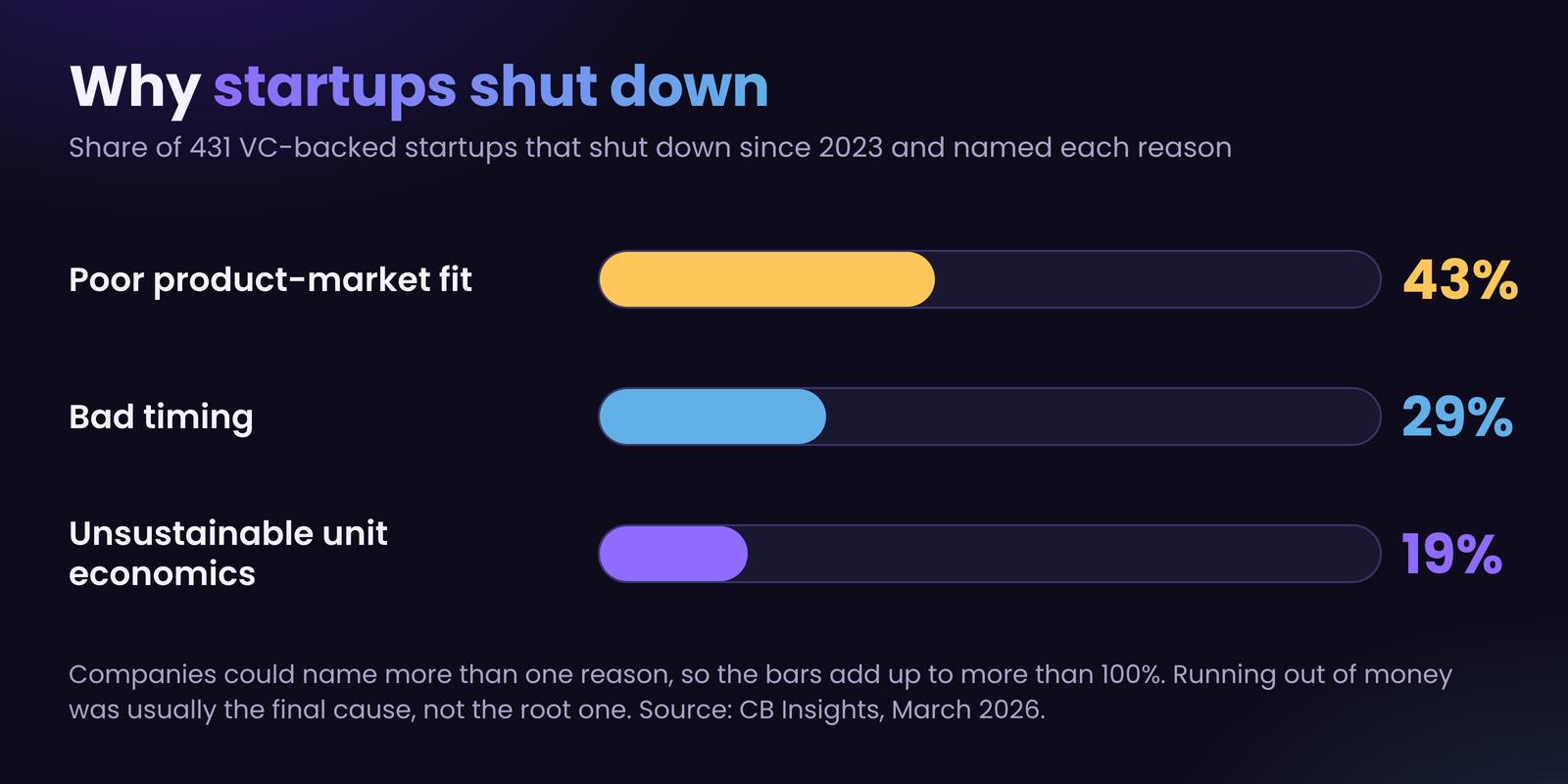
That finding changes what you should want from a development partner. A team that simply executes a long feature list can leave you with polished software nobody needs. A small studio that challenges your scope, and tells you what to skip, protects your runway.
2. Your money goes into the product, not the overhead#
Smaller teams carry less management overhead, so a larger share of your budget becomes working software. Large agencies can set high minimum budgets because their structure demands it. Small studios can start with a narrow, low-risk first step.
3. Communication stays simple#
Communication is one of the most common failure points in outsourced development. A 2017 survey of 42 experts at offshore outsourcing companies found that cultural differences, distance, language differences and a lack of informal, face-to-face contact were among the critical challenges in client relationships. A short chain from you to the team removes much of that risk.
4. Poor communication has a real cost#
When updates are unclear, small misunderstandings turn into rework, and rework costs money. For founders, clear and frequent updates are not a nice extra. They protect your budget, because a wrong turn gets caught in a day instead of a month.
Ready for a smaller, faster team? Book a free 30-minute call.
Small Studio vs Freelancer vs Large Agency vs AI Builder#
Founders usually compare four options, and they differ most on who you talk to, who manages the work and who is accountable for quality.

| Factor | Small founder-led studio | Freelancer | Large agency | AI app builder (DIY) |
|---|---|---|---|---|
| Who you talk to | A delivery lead, with the founder involved in scope and quality | One person | Account managers | Nobody (self-serve) |
| Team size | Right-sized specialists per project | One person, one queue | Large teams | None |
| Typical entry budget | Low, often a small fixed-price first step | Low | Often high minimums | Lowest upfront |
| Management load on you | Low when the team self-manages | High, you coordinate the work | Medium | High, you verify everything |
| Accountability for quality | The studio | The individual | The agency | You |
| Best for | Founders without a product team | Small, well-defined tasks | Large, long-running programs | Quick prototypes |
Small studio vs freelancer#
An expert freelancer is affordable and hands-on, and for a small, well-defined task that is often the right call. The limit is one queue: one person handles communication, code, testing and fixes, so everything waits in line. Hiring several freelancers solves that, but then you become the project manager. The hours you spend managing them can easily cancel out the lower rate. The right choice depends on whether you need one skill or a full product team.
A small studio sits in the middle. You get a team working in parallel, without the burden of coordinating several freelancers yourself.
Small studio vs large agency#
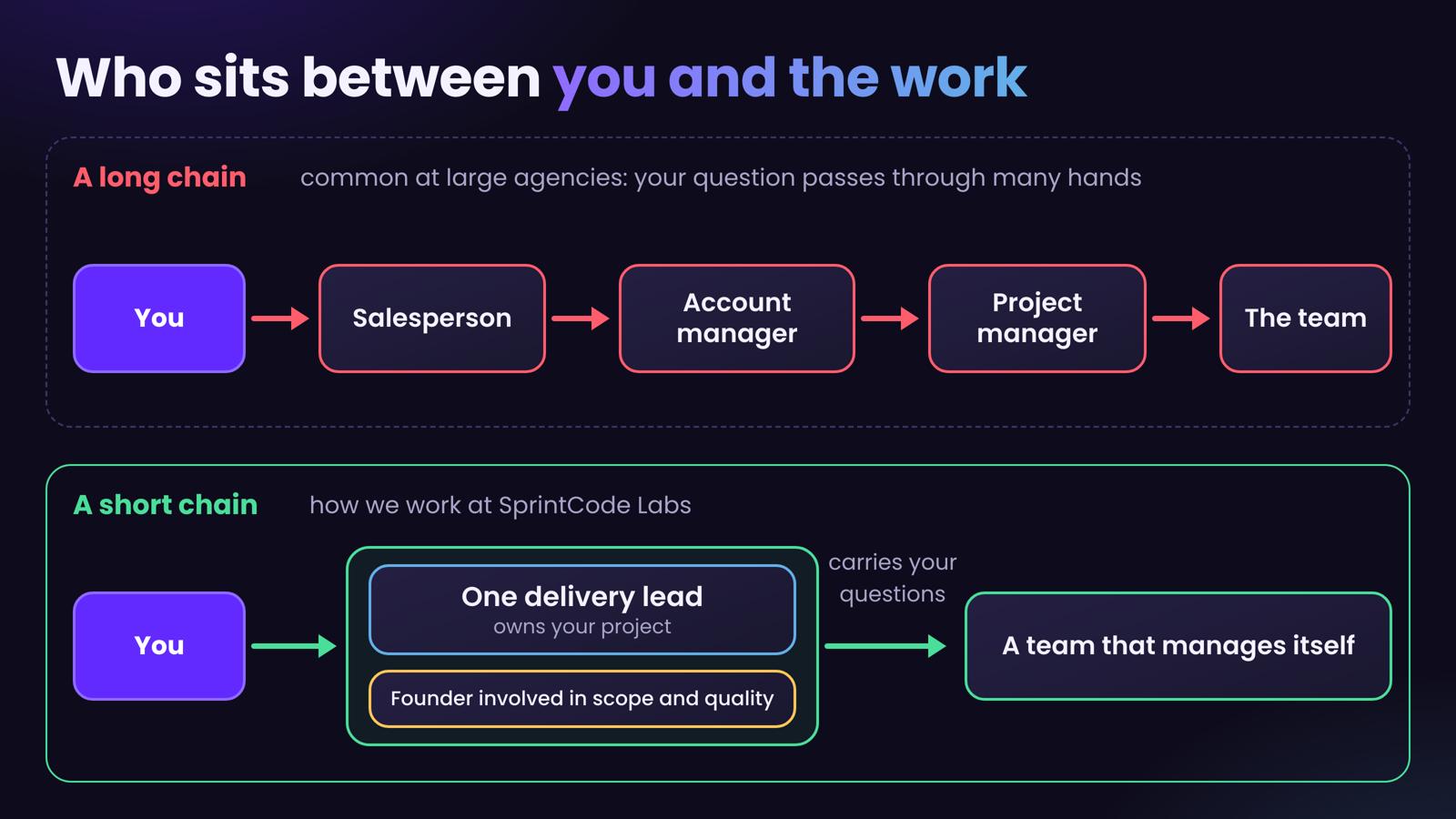
Large agencies often have high standards and a clean handover, and for large, long-running programs they can be the right fit. Where they tend to fall short for startups is the biggest-build bias, lock-in contracts and a heavy meeting load. A small studio can offer similar product thinking at a fraction of the entry cost, with one delivery lead who owns your project instead of a chain of account managers.
Small studio vs AI app builders#
AI builders are fast for prototypes, but nobody is accountable for security, correctness or scale. A good studio uses the same AI tools and adds experts who know when the output is wrong and who stand behind what ships.
What Does a Boutique Software Development Agency Cost?#
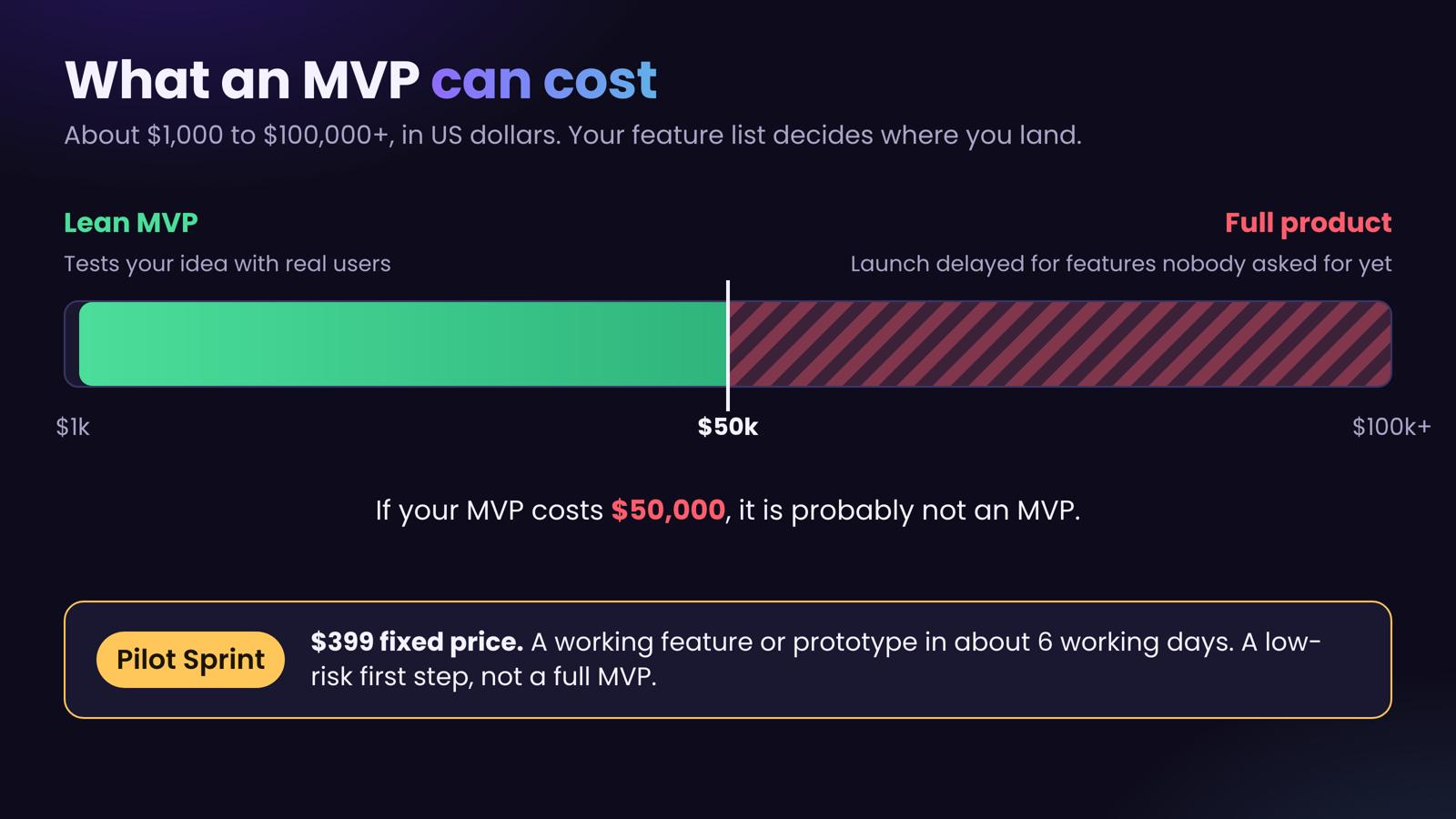
MVP prices vary enormously, from a very small tool to a full platform that runs well past $50,000. Our own estimates for a full MVP run from about $5,000 to $10,000 for a simple one to about $20,000 to $30,000 or more for a complex or AI-heavy one. Where yours lands depends on your feature list, so any number you hear before someone has seen that list is a ballpark, not a quote. (New to the term? Read What Is an MVP? first.)
The high end of the market is where many founders go wrong. The SprintCode view is that if your MVP costs $50,000, it is probably not an MVP. An MVP has one job: test your riskiest assumptions with real users, as cheaply and quickly as you can. Past $50,000, it has usually grown into a polished, full product, and the launch has been pushed back to build features nobody has asked for yet. That is an expensive way to find out whether people want it.
So build the leanest version that answers your biggest question, and let everything else wait. Once your first customers arrive, the work changes: you improve the product quickly based on what they tell you, instead of guessing up front.
What moves the price most:
- Number of features. Every extra feature adds design, build and testing time.
- Integrations. Payments, third-party APIs and data pipelines add complexity.
- Platforms. Web only is cheaper than web plus mobile.
Want a rough number for your own idea? Our cost calculator gives you one in under a minute.
How to reduce risk before committing a big budget#
The safest way to start is a small, fixed-price first step that produces something real. At SprintCode Labs, that is the Pilot Sprint: a $399 fixed price, delivered in about 6 working days, with a working feature or prototype at the end. You get daily updates on a shared board, and the code is yours and fully documented. It is a low-risk way to test us on a real piece of your product before a bigger build, and there are no lock-in contracts.
Want to test us on a real piece of your product first? Ask about the Pilot Sprint.
How to Find an Agency With a Short Chain of Communication#
If you are searching for an agency where you can talk directly to the developer, what you usually want is a short chain: clear answers, quickly, from someone who knows your project and is accountable for it. That does not have to mean chatting with every developer. At SprintCode Labs a delivery lead owns your project and carries your questions to the team, with the founder involved in scope and quality, so you never have to manage developers yourself.
Look for these signs before signing anything:
- One person owns your project. You should know who answers for the whole thing, so you never chase three people for one answer.
- The team is clear. You should know which roles will work on your product, such as design, backend and testing.
- Updates arrive without chasing. Daily updates and a live progress board beat weekly status meetings.
- Questions are easy to ask. Quick forms or messaging apps respect your calendar more than recurring meetings.
- Pricing is clear. A fixed-price first step shows the agency understands startup risk.
Good communication habits matter on both sides. The same survey of 42 experts lists a daily exchange of project status, an agreed communication protocol and a mix of communication tools among the practices that reduce coordination problems.
How SprintCode Labs Works as a Small Software Studio for Founders#
SprintCode Labs is a small software studio for founders based in Matara, Sri Lanka. Sachintha Gamage founded the company in 2018 as a self-taught freelance developer. It has since grown into a small, structured team that has delivered 43+ projects for clients in 9 countries, including the UK, USA, Canada, Singapore, the Netherlands, France and Sri Lanka, and works with 20+ long-term partners.
We are a product development studio, not a dev shop. You bring a business problem, and we hand back working software plus the judgment around it: what to build first, what to skip and what will break later.

What this looks like day to day#
- One person owns your project. A delivery lead is your single point of contact and carries your questions to the team. Sachintha, the founder, stays involved in scope and quality.
- Business first, then code. We build the most cost-effective option with the fastest time to market, not the biggest build we could sell.
- Freelancer-level cost, team-level speed. A team works in parallel instead of in one queue.
- Dynamic teams. Each project gets the specialists it needs, such as UI design, backend, data pipelines or AI.
- A team that manages itself. We find, fix, test and ship bugs inside the team. You get daily updates and a live progress board, and we only ask for input when it matters.
- Phone-first and async. We send questions as a quick form or a WhatsApp message, with no meetings that take over your calendar. One of our biggest e-commerce builds took just two meetings: a kickoff and a final demo.
- AI plus experts. We use the tools everyone has, such as Claude Code, Cursor and Codex. Our value is the people who know when the AI is wrong and who stand behind what ships.
- Written scope, senior review, free fixes. In our projects, the scope is written down before any code, a senior engineer reviews every change, and bugs are fixed for free for 30 days after delivery.
A small studio is not the right fit for every job. If you need a large in-house-style team or weekly status meetings, a bigger agency will suit you better. If you only want to test interest in an idea, a landing page will tell you more for far less.
What we build#
- Custom web applications and MVPs
- Data and AI platforms
- Multi-tenant SaaS products
- E-commerce stores with design systems and ongoing care
- Booking platforms and websites, plus branding and social content
- Hosting, maintenance and care plans for delivered products
Have a product idea or a live product that needs a team? Talk to us.
7 Questions to Ask Before You Hire a Small Software Agency#
Use this checklist when comparing any founder-led software agency or boutique studio.

- Who will I talk to every week? You want a named person who knows your project and can answer without a relay, such as a lead who owns delivery, not only a salesperson.
- Who owns the code and the accounts? You should own both from day one.
- Is there a lock-in contract? Short commitments reduce your risk.
- What will you tell me not to build? A good studio cuts scope, not just adds to it.
- How do you use AI, and who checks the output? Ask who is accountable for security and correctness.
- How will I see progress? Look for daily updates and a live board.
- Is there a small, fixed-price way to start? A paid pilot beats a long proposal.
Not sure which option fits? Send us your questions.
Frequently Asked Questions#
What is a founder-led software agency?#
A founder-led software agency is a software company where the founder stays involved in client work. Clients usually get a founder who stays close to scope and quality, plus a small senior team with few layers and few hand-offs.
Why choose a small software development agency for startups?#
Startups have limited cash and time, and small agencies are built for that. They typically offer lower entry budgets, faster decisions and simpler communication than large agencies, which tend to set high minimum budgets and run more meetings.
What is a boutique software development agency?#
A boutique software development agency is a small, specialised firm that takes fewer clients and gives each one more attention. It trades the scale of a large agency for closer collaboration and more senior involvement.
Is a small software studio better than a freelancer?#
It depends on the job. A freelancer suits small, clearly defined tasks. A small studio suits a full product, because a team works in parallel and manages itself, so you do not have to coordinate designers, developers and testers yourself.
Can I talk directly to the developer at a software agency?#
At many large agencies you mostly deal with account managers. At a small founder-led studio you usually deal with someone much closer to the work. That does not always mean chatting with each developer, and it does not need to. What matters is a short chain and one person who owns the answers. At SprintCode Labs one delivery lead owns your project and takes your questions to the team, with the founder involved in scope and quality, so you never have to manage developers yourself. Ask in your first call who you will speak to during the project.
How much does it cost to build an MVP?#
Our estimates run from about $5,000 to $10,000 for a simple MVP to about $20,000 to $30,000 or more for a complex or AI-heavy one, and the final price depends on your feature list. The SprintCode view is that if the budget goes past $50,000, it has usually turned into a full product, so start with the leanest build that tests your idea. Our cost calculator gives you a rough range, and a fixed-price first step, such as our $399 Pilot Sprint, lets you test how we work on a real piece of your product first. Ask about the Pilot Sprint.
How long does it take to get a first working version?#
It depends on scope, but a focused first version can be quick. Our Pilot Sprint delivers a working feature or prototype in about 6 working days.
Do small agencies use AI to build software?#
Most do, including us. The difference is accountability. We use AI tools such as Claude Code, Cursor and Codex, and our experts review the output and stand behind what ships.
Who is SprintCode Labs best for?#
We work best with non-technical founders in the US and UK who have a live product or a clear idea and no in-house product team. We also help Sri Lankan SMEs with websites, e-commerce and content.
Still have a question? Ask us.
Final Thoughts#
Picking a development partner is one of the biggest early decisions a founder makes. A founder-led software agency gives you a small senior team, a founder who stays involved in the work and a lower-risk way to start. The SprintCode view is that the best fit is a studio that challenges your scope, shows progress without being chased and puts its name behind the result.
If you want a small software studio for founders with a short chain from your question to the answer, we would like to hear about your product.
Take the next step: Tell us about your product.
Written by the SprintCode Labs team, a senior product team that builds MVPs and custom software for founders.