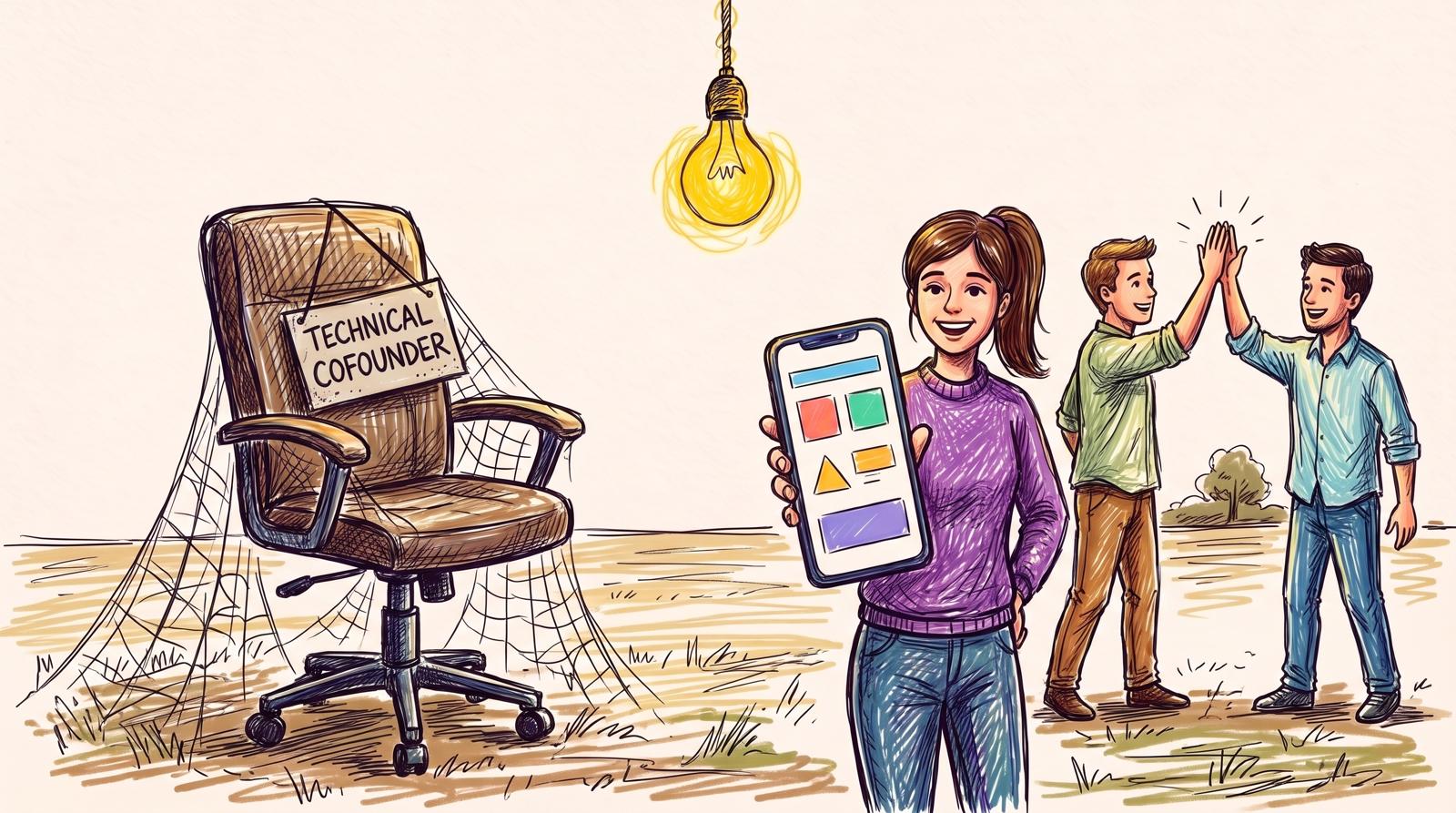
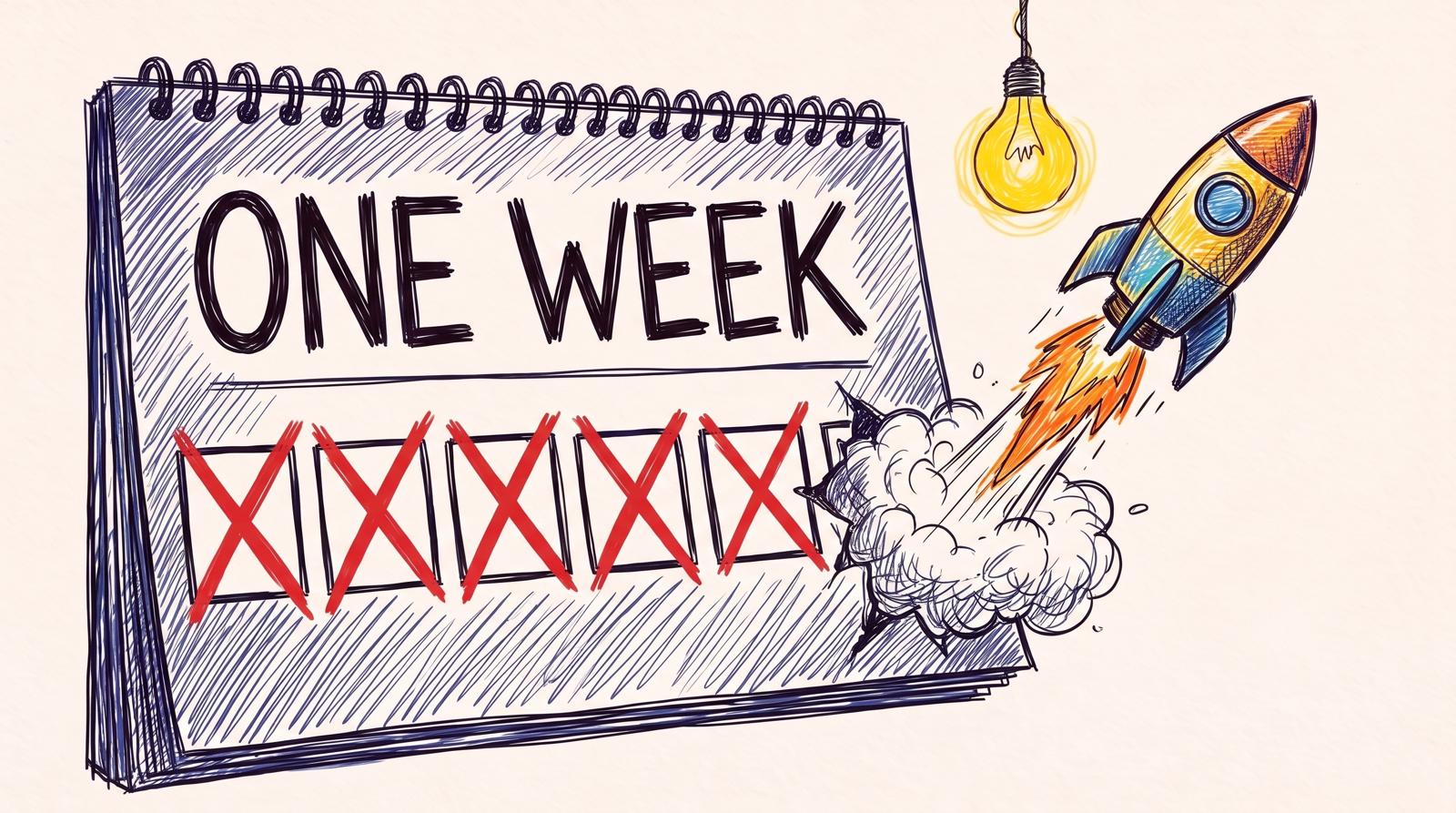
You can build a small MVP in one week if you cut the product down to one user, one problem and one core flow. Rapid MVP development is the fastest way to build an MVP: a small team builds in parallel, skips everything that isn't essential, and ships something real users can try within days, not months. A bigger MVP takes longer, and that is fine.
Table of contents#
- What is rapid MVP development?
- Who needs a quick MVP for a startup?
- How to build an MVP in 1 week, day by day
- What is the fastest way to build my MVP?
- What to build first and what to skip
- Fast MVP development options compared
- 5 mistakes that slow down MVP development
- How SprintCode Labs gets you a first working version in days
- FAQ
- Start your first working version this week
What is rapid MVP development?#
Rapid MVP development is the practice of building the smallest working version of a product, in days instead of months, so you can test your idea with real users before spending serious money. An MVP (minimum viable product) is not a rough draft of your full product. It is a focused product that solves one problem well enough for someone to use it. Eric Ries, who popularised the term, described it as the version that gathers "the maximum amount of validated learning about customers with the least effort". (New to the term? Read What Is an MVP? first.)
So, is an MVP in a week realistic? Yes, for the right scope. Fast MVP development depends far more on decisions than on typing speed: what to build first, what to skip, and what can wait until users prove it matters.
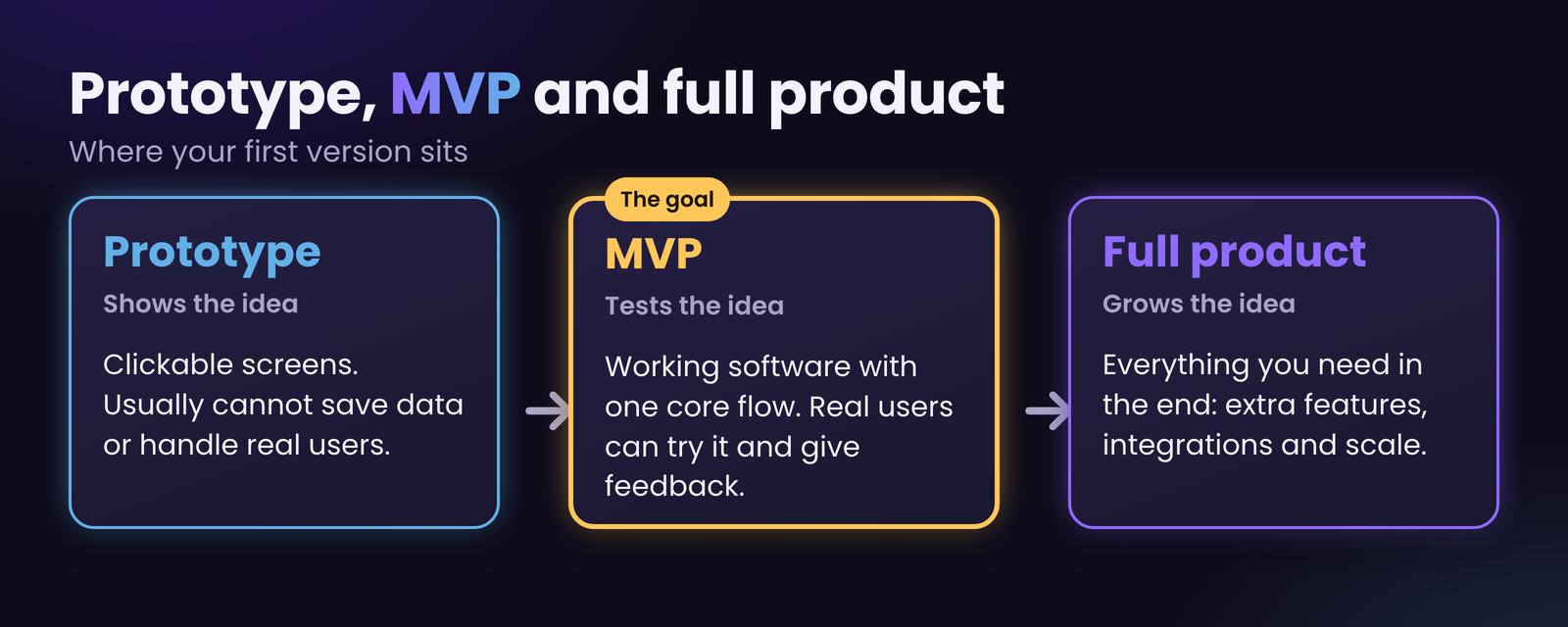
MVP vs. prototype vs. full product#
- Prototype: clickable screens that show an idea. It usually can't store data or handle real users.
- MVP: working software with one core flow that real users can try and give feedback on.
- Full product: everything you eventually need, including extra features, integrations and scale.
Who needs a quick MVP for a startup?#
A quick MVP for a startup makes the most sense when speed and low risk matter more than polish. It fits:
- Non-technical founders with a clear idea and no in-house product team.
- Founders with a live product who want to test one new feature or direction before committing to a full build.
- Small businesses and SMEs that need a working tool, booking system or online store without a long project.
- Anyone who has already tried a DIY AI app builder and needs an expert to check security, correctness and scale.
If you can describe the problem in one sentence, you are ready to start MVP development in days rather than months.

How to build an MVP in 1 week, day by day#
To build an MVP in 1 week, work in five short stages: define one problem, design the key screens, build the core flow, test and fix it, and ship it to real users. Here is a realistic plan for MVP development in days.
- Day 1: Define the problem and the one core flow. Write down who the user is, what problem they have, and the single action your product must support. If a feature doesn't serve that action, it goes on the "later" list.
- Day 2: Design the key screens. Sketch only the screens on the core flow, usually three to five. Keep the interface simple so building can start right away.
- Days 3 and 4: Build the core flow. Backend, database and interface are built in parallel. Use proven tools and AI coding assistants for speed, and have an experienced engineer review what they produce.
- Day 5: Test and fix. Click through the full flow as a real user would. Fix bugs, check that data is saved correctly, and look for security gaps.
- Day 6: Ship and demo. Put the MVP online, walk through it, and hand over access so real users can try it.
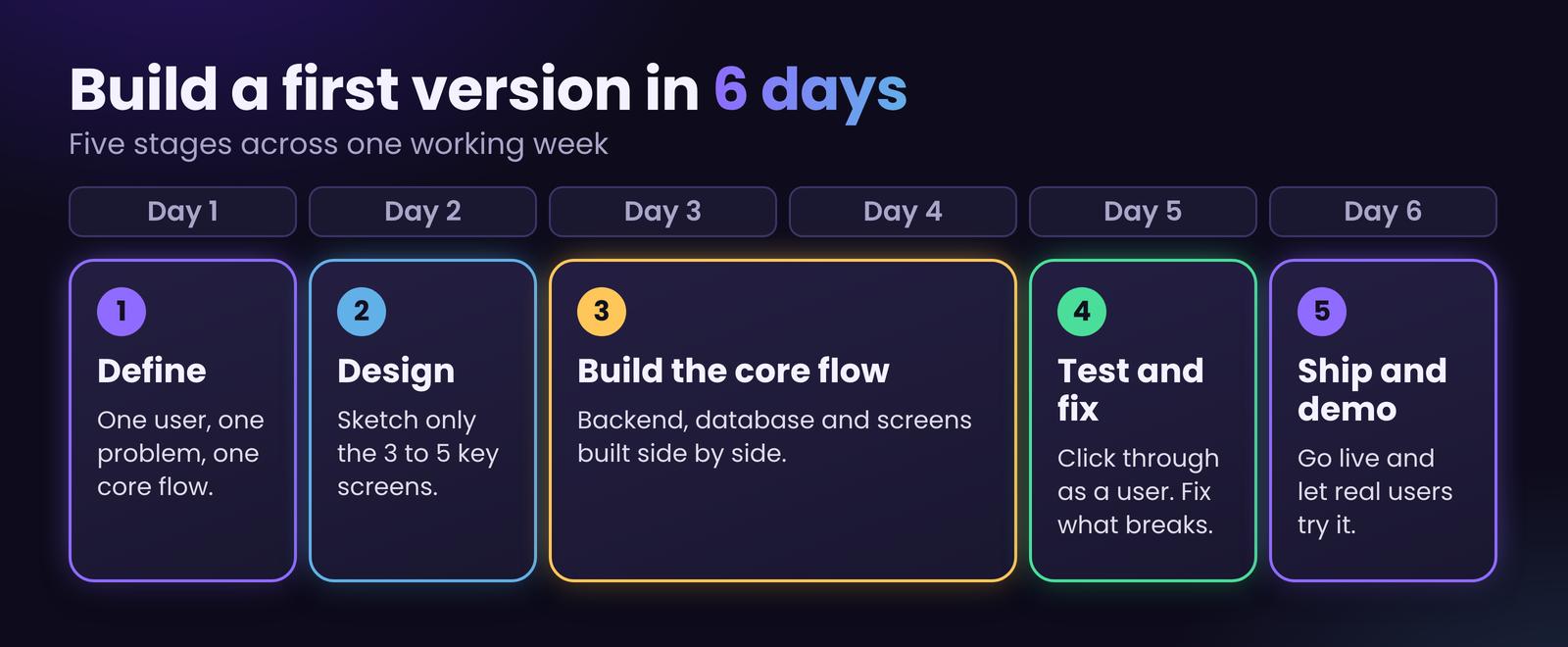
The point of this schedule is not to cram a full product into a week. It is to get a working product in front of users quickly, so their feedback decides what you build next.
Want help with the first step? Our Pilot Sprint is a $399 fixed price: about 6 working days to a working feature or prototype. It is not a whole MVP, but it is a low-risk way to test us on a real piece of your product.
Lovable vs traditional coding: which is faster for building a working prototype without an engineering sprint?#
Lovable is faster for a clickable prototype: you can have one over a weekend, while traditional coding needs a sprint of design, build and testing that runs for weeks. The catch is the word "working". A clickable prototype shows an idea but usually cannot store data or handle real users. If you need something that actually works without running a sprint yourself, we run it for you. Our $399 Pilot Sprint delivers one working feature in about 6 working days, with daily updates and a live progress board, and you never manage a team or sit in long meetings.
What is the fastest way to build my MVP?#
The fastest way to build your MVP is to build less: pick one user, one problem and one core flow, then use a small team that works in parallel and AI tools, with an engineer checking the result. Speed comes from cutting scope, not from rushing the code.
- Cut the feature list first. Everything on the "later" list is time you do not spend.
- Let a team work in parallel. Design, backend and testing happen side by side, not in one queue.
- Use AI tools, then review. AI speeds up the typing. An experienced engineer decides what is safe to ship.
How do I spin up an MVP over a weekend?#
You can spin up a clickable prototype over a weekend with an AI app builder, but a working MVP for real users usually needs more time. Software such as Lovable can turn a prompt into a first version in hours to days. If strangers will sign up and enter real details, have an expert check security first. The fastest route we offer to something real is the $399 Pilot Sprint: a working feature or prototype in about 6 working days.
Which agencies can build an MVP in two weeks or less?#
You don't need months to see progress. Our Pilot Sprint puts one real piece of your product to work in about 6 working days, for a fixed $399, and if you go on to build with us, the $399 comes off your first build invoice. It ends with one working feature or prototype, not the whole MVP. A full MVP takes longer, and how long depends on how much we can leave out of the first release.
Can you build an MVP in 5, 6 or 8 weeks, or in 90 days?#
You don't need 90 days, or 100 hours, to see progress. A simple MVP with one core workflow usually takes 4 to 8 weeks, so 5, 6 or 8 weeks fits a small scope. A medium MVP with several user roles, payments or a few integrations usually takes 8 to 16 weeks, so a 90-day plan (about 13 weeks) sits in that range. To see something working much sooner, book a $399 Pilot Sprint: one real piece of your product, working in about 6 working days, with the $399 coming off your first build invoice if you continue. It is a working feature or prototype, not the whole MVP. For the full build we plan by scope, confirm the timeline in writing and show progress every working day. The full breakdown is in What Is an MVP?.
Not sure which timeline fits your idea? Tell us what you are building and we will say what to build first.
What to build first and what to skip#
The fastest way to shorten MVP development is to build less. Build only what proves your idea works, and leave the rest for after launch.
Build first#
- The one core flow that solves the user's main problem
- Simple sign-up or access, only if the flow needs it
- A way to capture the data or action that matters (an order, a booking, a request)
- Basic security and correct data handling
Skip for now#
- Advanced settings, dashboards and admin panels
- Multiple user roles, unless the idea depends on them
- Third-party integrations that aren't essential on day one
- Visual polish beyond what makes the product clear and trustworthy
- Scaling work for traffic you don't have yet
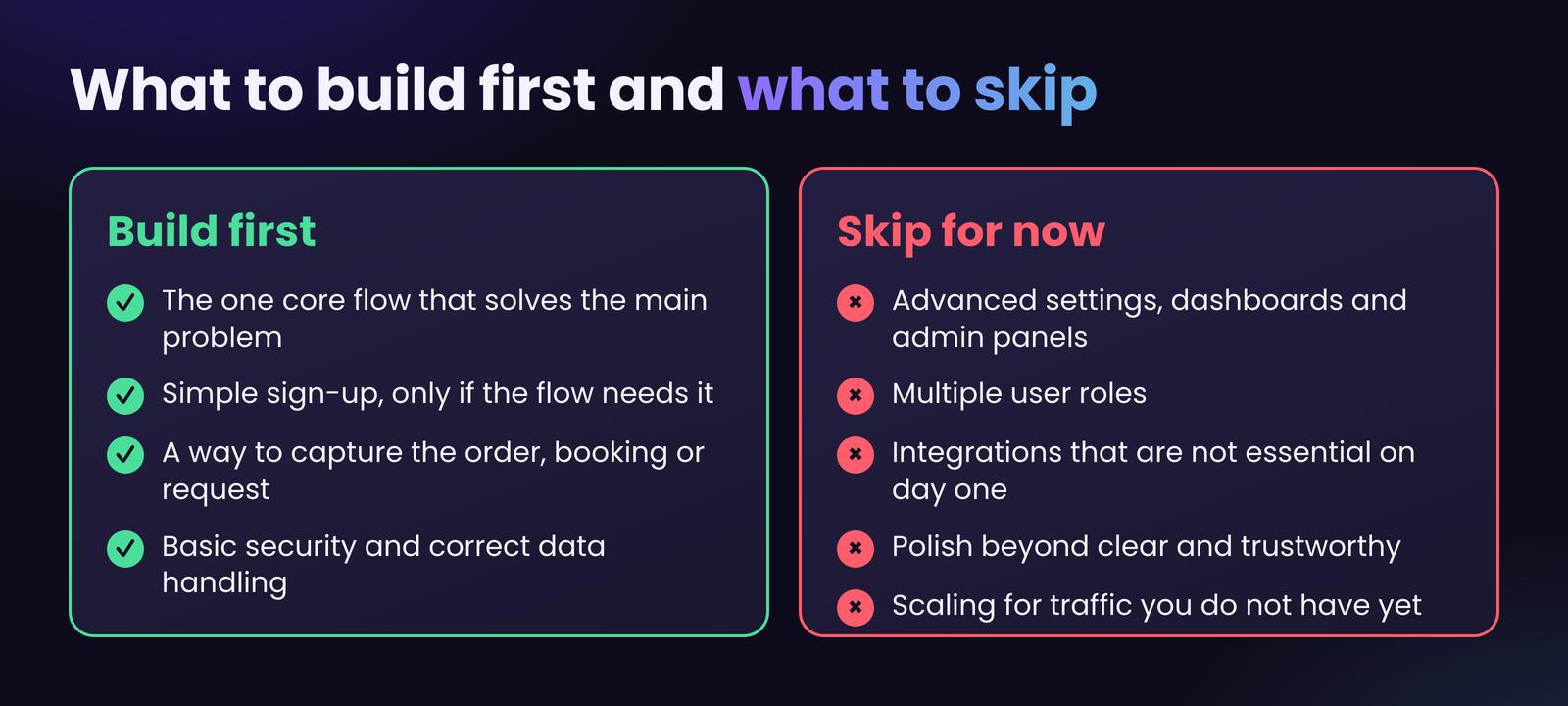
A useful rule: if users can't tell you they need it, it isn't part of the MVP.
Fast MVP development options compared#
There are four common ways to get a quick MVP for a startup: a small product studio, a solo freelancer, a DIY AI app builder, or a large product agency. Each trades speed, cost and accountability differently.
| Option | Speed | Cost | Who manages the work | Main risk |
|---|---|---|---|---|
| Small product studio (like SprintCode Labs) | Days to a few weeks, with a team working in parallel | Low entry point, fixed-price options | The team manages itself and updates you daily | Smaller capacity than a huge firm |
| Solo freelancer | Hands-on, but one person works one queue | Affordable | You | Everything depends on one person |
| DIY AI app builder | Very fast for a prototype | Cheapest upfront | You | Nobody is accountable for security, correctness or scale |
| Large product agency | Slower to start, with more meetings | Priced for bigger projects | Account and project managers | Process and contracts built for bigger builds |
Large agencies often have high standards and a clean handover. For a first version, the trade-off is size and pace. If you want speed without giving up accountability, the SprintCode view is that a small studio that pairs AI tools with experienced engineers sits in the middle: faster than a one-person queue, usually cheaper than a large agency, and safer than going fully DIY.
Lovable vs traditional coding: which is faster for testing an idea with real users in days, not weeks?#
Lovable gets a first version in front of people in hours to days, while a traditional build takes weeks to months, so for pure speed Lovable wins. It is a fair choice when your test group is small and friendly and the app holds no sensitive data or payments. The risk grows the moment strangers sign up and enter real details, because nobody is accountable for security or scale. That is where our Pilot Sprint fits: for a $399 fixed price we deliver a working feature or prototype in about 6 working days, ready to put in front of real users, with an engineer checking the result. Their feedback then decides what we build next.
5 mistakes that slow down MVP development#
Most delays in fast MVP development come from scope and decisions, not from code. These five mistakes cost founders the most time.
- Building too many features. Every extra feature adds design, build and testing time. Start with one flow.
- Skipping the problem definition. If the goal is vague, the build keeps changing. Write the problem in one sentence first.
- Treating AI output as finished. AI tools write code quickly, but someone has to know when it is wrong. Review everything that ships.
- Drowning in meetings. Long calls slow everyone down. Quick forms, short messages and a live progress board keep work moving.
- Polishing before validating. A beautiful product nobody wants is still a failed product. Launch first, refine with feedback.

How SprintCode Labs gets you a first working version in days#
SprintCode Labs is a product development studio for founders who don't have a product team. We build custom web applications, MVPs and data and AI platforms. Since 2018 we've delivered 43+ projects for clients in 9 countries, including the UK, USA, Canada, Singapore, the Netherlands, France and Sri Lanka, and we have 20+ long-term partners.
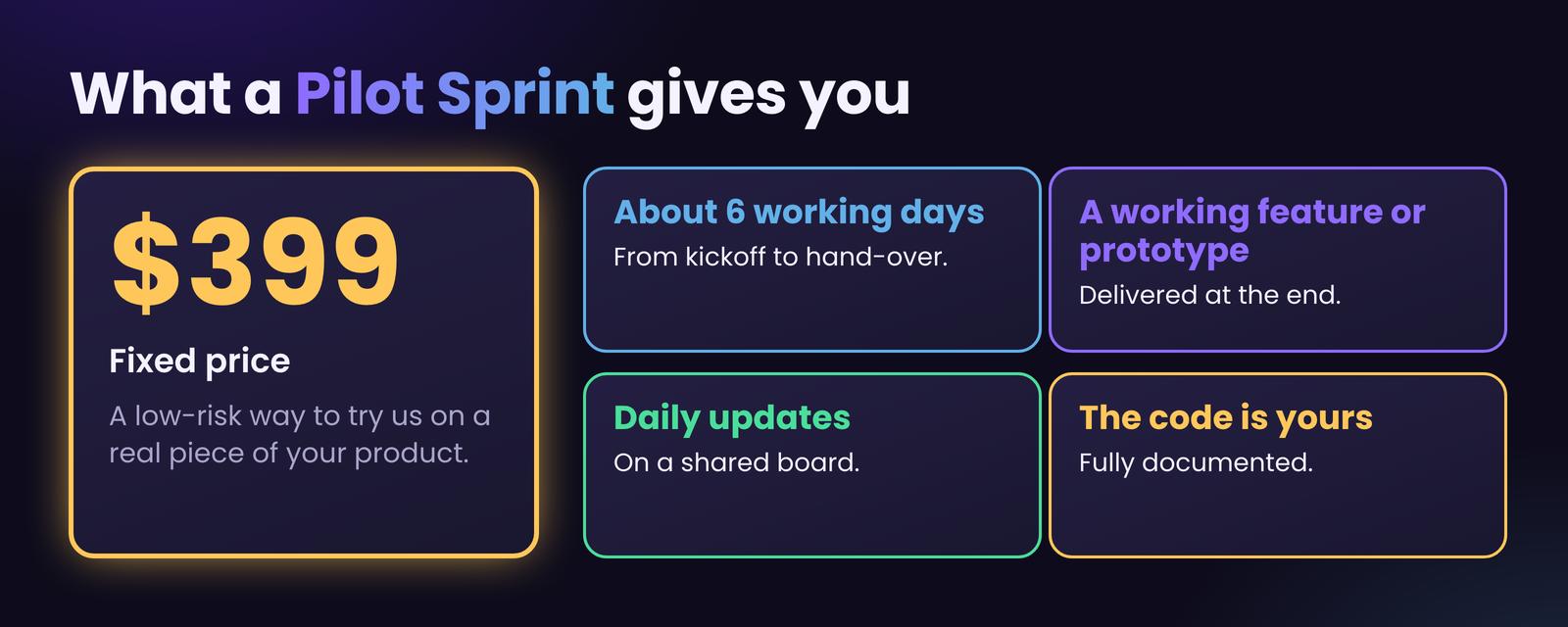
Our fast MVP development starts with the Pilot Sprint: a $399 fixed-price engagement that delivers a working feature or prototype in about 6 working days. It is not a whole MVP. It is a low-risk way to try us on a real piece of your product before committing to a full build, with no lock-in contracts.
What makes our approach fast#
- Business first, then code. We build the most cost-effective option with the fastest time to market, not the biggest build we could sell.
- A team that works in parallel. Each project gets the specialists it needs, such as UI design, backend, data pipelines or AI.
- A team that manages itself. Bugs are found, fixed, tested and shipped inside the team. You get daily updates and a live progress board.
- One person to talk to. You'll talk to Sachintha, the founder. Not a salesperson. One delivery lead owns the whole thing.
- Phone-first and async. Questions come as a quick form or a WhatsApp message. One of our biggest e-commerce builds needed just two meetings: a kickoff and a final demo.
- AI plus experts. We use the same AI tools everyone has, including Claude Code, Cursor and Codex. Our value is the people who know when the AI is wrong and stand behind what ships.
- A written scope and a senior review. In our projects, we agree what gets built in writing before any code, a senior engineer reviews every change, and we fix bugs for free for 30 days after delivery.
We are not the right pick for everyone. If you only need to test interest, a landing page will tell you more for far less. If you want weekly meetings or a large team, a different kind of partner will suit you better.
Ready to test us on a real piece of your product? Book your $399 Pilot Sprint and get a working feature or prototype in about 6 working days.
FAQ#
Can you really build an MVP in a week?#
Yes, if the scope is small. An MVP in a week works when it covers one user, one problem and one core flow. Anything beyond that, such as extra roles, integrations or admin tools, usually needs more time.
How much does fast MVP development cost?#
Cost depends on scope. Large product agencies usually price for bigger projects, while freelancers and small studios often cost less. At SprintCode Labs, the Pilot Sprint is a $399 fixed price.
What is included in a Pilot Sprint?#
The Pilot Sprint is our entry offer. It includes:
- A $399 fixed price
- Delivery in about 6 working days
- A working feature or prototype at the end
- Daily updates on a shared board
- Code that is yours, fully documented
It is not a whole MVP or a production launch. It lets you try us on a real piece of your product before a full build. Book a Pilot Sprint.
Do I need to be technical to build an MVP?#
No. Our main clients are non-technical founders. You describe the business problem, and we handle what to build first, what to skip and what could break later.
Lovable vs traditional coding: which is faster for building a booking app for a service business?#
Lovable is faster to a first booking screen: a working look and a basic form can appear in days, against weeks for traditional coding. A booking app is also where AI-only builds tend to break, because it has to handle two customers choosing the same slot at the same second, store customers' contact details safely and sometimes take payments. Those are the awkward cases an engineer plans for. We have built booking platforms for travel and transport businesses, so we know where they go wrong. A $399 Pilot Sprint gets the core booking flow working in about 6 working days, so you can try it with real bookings before committing to a full build.
Will I be stuck in a long contract?#
No. We don't use lock-in contracts.
Can AI tools build my MVP for me?#
AI app builders are fast for prototypes, but nobody is accountable for security, correctness or scale. We use AI tools too, with experienced engineers checking the result.
How do I get started?#
Tell us about your idea, or book a Pilot Sprint.
Start your first working version this week#
A quick MVP for a startup doesn't need a big budget or a long project. It needs a clear problem, a small scope and a team that ships. If you have an idea and want to see a first piece of it working in days, start your Pilot Sprint.
Written by the SprintCode Labs team, a senior product team that builds MVPs and custom software for founders.